
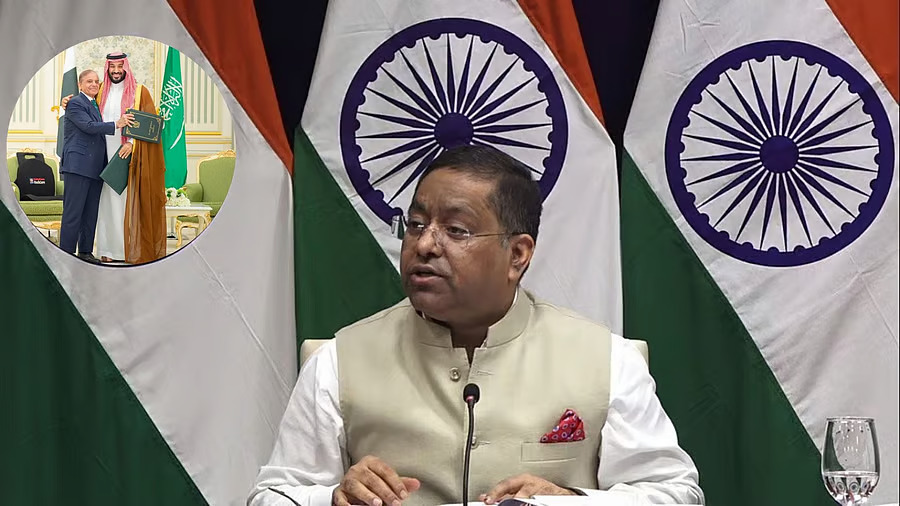
Saudi Arabia and Pakistan formally signed a Strategic Mutual Defence Agreement. One of the central provisions of this agreement states: any aggression against either signatory shall be considered aggression against both.
The move triggered a measured response from India’s Ministry of External Affairs (MEA), which emphasized that while India values its “wide-ranging strategic partnership” with Saudi Arabia — deepened in recent years — it expects that any future strategic choices or pacts involving Riyadh will take into account “mutual interests and sensitivities.”
What India Is Emphasizing
Strategic Depth with Saudi Arabia
India points out that the bilateral ties with Saudi Arabia go well beyond diplomatic formality: they include energy trade (oil, LPG), joint projects in petrochemicals, refinery cooperation, and more. These are long-term, substantial engagements that make any new strategic alignments by Riyadh especially significant for India.
Sensitivities & Mutual Interests
By using phrases like “mutual interests and sensitivities”, the MEA is signaling that India expects respect for its concerns — strategic, security, geopolitical — in future pacts. It’s a diplomatic way of saying that while India does not oppose Saudi Arabia entering into defence or security agreements, it expects consultation, awareness, and consideration of how such agreements might affect India’s regional posture.
Studying Implications
India is also said to be carefully analysing the content of the Saudi-Pakistan agreement — its terms, scope, and potential regional or global security ramifications. This implies that India is not reacting with alarm, but with vigilance.
Why This Matters: Bigger Geopolitical Picture
The pact between Saudi Arabia and Pakistan has stirred interest because:
Pakistan’s nuclear status adds a layer of complexity. Given Pakistan is a nuclear-armed state, any defence agreement with Saudi Arabia may raise questions about deterrence, balance of power, and strategic signaling in South Asia.
Regional security dynamics are shifting. With conflicts, alliances, and diplomatic priorities in flux (Middle East turbulence; India-Pakistan relations; competition among global powers), every new treaty or pact becomes part of a larger matrix that is closely watched.
India’s energy and economic ties with Saudi Arabia are deep. Saudis are major suppliers of petroleum, and India has been engaging Saudi Arabia across energy, trade, infrastructure and investment sectors. If those relationships are impacted, there could be economic fallout.
Possible Diplomatic Concerns
Here are a few of India’s concerns (explicit or implicit):
Strategic Imbalance: If Saudi Arabia is perceived as aligning too closely with Pakistan, especially in defence, this might alter how India perceives its strategic buffer or security dynamics in South Asia.
Nuclear Implications: Since Pakistan has nuclear arms, some observers wonder whether the defence pact gives Riyadh assurances or a kind of deterrence backing, and how that might shift regional equations.
Precedent Setting: If this pact sets off more defence agreements in the region without broad consultation, India might feel sidelined or pressured into recalibrating its own defence diplomacy.
What to Watch Next
Whether India raises this issue in diplomatic channels with Saudi Arabia directly — formal talks, state visits, strategic dialogues.
Clauses and operational details of the Saudi-Pakistan pact once they are made public; what obligations and rights are involved.
How Saudi Arabia addresses India’s expectations: whether Saudi officials publicly reaffirm respect for India’s interests and concerns.
If India adjusts its foreign policy or strategic posture in response — possibly in terms of stronger ties with other Gulf states, defense pacts, or renewed investment in its own regional security capabilities.
Responses from Pakistan — how Islamabad frames the agreement; whether it reassures neighbours or emphasizes the defensive nature of the pact.
Concluding Thoughts
The signing of the defence pact between Saudi Arabia and Pakistan is a notable development in contemporary geopolitics. India’s reaction has been cautious but clear: strategic partnerships must be managed with awareness, accountability, and respect for existing relationships.
Our Services – FACTS Transcripts
We at FACTS Transcripts assist in various services, including:
Mark Sheet Transcripts
E-Transcripts
Duplicate Mark Sheets & Degree Certificates
Medium of Instructions Certificates
Attestations
HRD Attestation / Apostille Services
ECA (Educational Credentials Assessment)
Trusted by leading global verification organizations, including WES, IQAS, PEBC, NDEB, NASBA, CAPR, NZQA, ICAS, NCESS, ICES, ECE, eduPASS, ACEI, GCEUS, Comparative Education Services, NNAS, NCA, SAQA, QMAS, FORAC, Australian Pharmacy Council, and more.
FACTS Transcripts – The preferred choice for university document verification worldwide. We ensure a hassle-free process for obtaining your transcripts.