

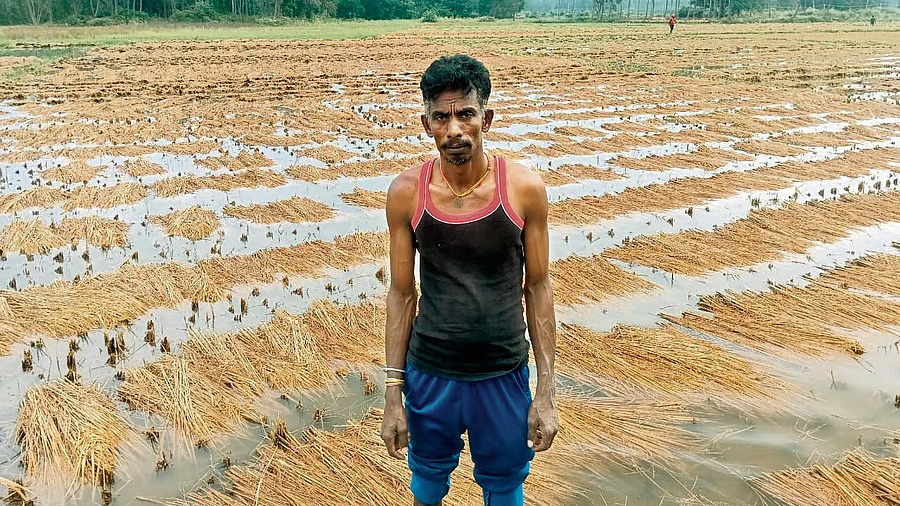
In a devastating turn of events, heavy unseasonal rain has wreaked havoc on paddy fields across Malavalli taluk in Karnataka, leaving farmers reeling from massive crop losses. What was supposed to be a period of agricultural hope and anticipation has turned into a season fraught with despair, as rain-soaked fields and damaged crops threaten rural incomes, food security and the resilience of farming communities.
The unexpected downpour, occurring outside the region’s regular monsoon cycle, has emerged as a stark reminder of the growing unpredictability of climate patterns and the vulnerability of India’s agricultural heartland.
The Scope of the Damage: Paddy Fields Submerged and Destroyed
Malavalli taluk, known for its fertile alluvial soil and extensive paddy cultivation, was gearing up for the harvest season when the region was hit by intense rainfall. Unlike the typical monsoon rains, this downpour arrived after crops had matured — a critical period when fields are most sensitive to waterlogging.
The consequences were swift and severe:
Vast stretches of standing paddy were submerged under water.
Crop stalks bent and broke under the weight of persistent rain.
Grain heads rotted before they could be harvested.
Many low-lying agricultural plots now lie waterlogged and unfit for cultivation.
Farmers who had invested months of labor, expense on seeds, fertilisers, and irrigation, saw their livelihoods literally washed away overnight.
Farmers Speak Out: Loss, Anguish and Economic Fear
Conversations with affected farmers reveal a picture of deep distress. Many spoke of sleepless nights as they watched their crops succumb to flooding.
“We worked hard through the season, hoping for a good harvest,” said one farmer, his voice heavy with emotion. “But this rain came when we least expected it. We have nothing now — no rice to sell, no income to support our families.”
Another cultivator described rescuing livestock and household belongings as rainwater breached farm boundaries and entered homes. Outside the fields, pockets of community members were seen attempting to salvage whatever produce they could — a heartbreaking effort against overwhelming odds.
Agricultural Experts Point to Climate Variability
Agricultural scientists and meteorologists have noted that unseasonal rains are becoming increasingly common in many parts of India. While traditional monsoon patterns once provided a predictable rhythm for sowing and harvesting, climate variability linked to broader environmental shifts appears to be disrupting age-old agricultural timelines.
Experts warn that such erratic weather events are not only harmful to current crops but could force farmers to rethink cropping calendars, irrigation strategies, and even choice of crop varieties in the future.
The distress in Malavalli — where paddy is the dominant crop — exemplifies how sudden weather anomalies can devastate local food systems and unsettle rural economies.
Economic Impact: Ripples Across Rural Markets
For Malavalli’s agrarian communities, the economic impact goes beyond the fields. Paddy cultivation is not simply about harvesting rice; it supports a wide network of labourers, transport workers, small traders, and local service providers.
With paddy crops destroyed:
Daily wage workers may find fewer employment opportunities.
Local ration shops and dealers could face supply shortages.
Transporters and milling operations may experience reduced business.
Rural spending and demand in market towns may decline sharply.
In essence, the loss of paddy is not just a setback for farmers — it is a blow to the entire rural economic ecosystem.
Government and Administrative Response: Relief Measures and Support
In the wake of the crisis, local authorities and agricultural officials have rushed to assess the damage and coordinate relief efforts. Teams have conducted field visits to estimate the extent of crop loss and map the worst-hit areas. Early responses include:
Formal damage assessments to initiate claims for compensation.
Communication with state agricultural departments to expedite relief packages.
Discussions on whether crop insurance schemes will be activated for affected farmers.
Consideration of fodder support for livestock and short-term financial help.
Officials emphasised that accurate and timely data from farmers — including crop records and planting details — is critical to ensure that compensation reaches those who need it most.
The Role of Crop Insurance: A Vital Safety Net
Crop insurance schemes, designed to protect farmers against natural calamities, are expected to be a key mechanism for mitigating the financial impact of this disaster. However, the effectiveness of such schemes depends heavily on timely registration, accurate loss verification, and swift release of compensation funds.
For many farmers in Malavalli, relying on crop insurance is not a luxury but a necessity — a buffer that could mean the difference between debt and recovery.
Agricultural officials have urged farmers to collaborate with local revenue and agriculture department representatives to complete necessary documentation, ensuring they are eligible for claims.
Community Support: Neighbours Help Neighbours
Amid the devastation, stories of community resilience have emerged. In several villages, neighbours have come together to check on elders, share remaining food supplies, and assist each other in clearing waterlogged fields.
Women’s self-help groups have organised collective efforts to support families most affected by the rain. Neighbours without crop loss have opened their homes to those facing structural damage from water intrusion.
These communal actions underscore the deep bonds that sustain rural societies during times of hardship.
Long-Term Implications: Reimagining Agriculture in the Face of Climate Stress
Malavalli’s paddy crisis raises broader questions about the future of agriculture, climate adaptation, and rural security:
Should planting and harvesting calendars be adjusted in anticipation of changing weather patterns?
Are farmers equipped with the tools, knowledge, and resources to practise climate-smart agriculture?
How can local irrigation and drainage systems be improved to withstand unseasonal deluges?
What policies are needed to protect farmers from income shocks due to erratic weather?
These questions are not unique to Malavalli; they resonate across many farming belts in India where climate variability is increasingly affecting agricultural outcomes.
Voices from Agricultural Analysts
Experts call for urgent investment in climate-resilient farming practices — including drought-resistant and flood-tolerant crop varieties, improved water management systems, and enhanced weather forecasting tools tailored to local conditions.
They also emphasise the importance of empowering farmers through education and technology — enabling them to interpret weather alerts, access timely advisories, and make informed decisions about crop choices and field management.
Policy Challenges and the Way Forward
Policymakers face complex challenges in balancing short-term relief with long-term adaptation. Immediate needs include:
Rapid disbursement of compensation to affected farmers.
Provision of low-interest credit and support for re-planting efforts where feasible.
Strengthening local agricultural extension services to guide next steps.
Longer-term strategies must include:
Enhancing rural drainage infrastructure.
Supporting community-level water conservation and land management initiatives.
Expanding access to crop weather insurance and digital advisory systems.
Encouraging diversification into crops and practices more resilient to climatic unpredictability.
Human Stories: Behind the Fields of Mud and Grain
For many farmers, memories of this season’s paddy loss will linger long after the floodwaters recede. There are stories of children watching their parents grapple with the loss of expected income; elders reflecting on changing weather patterns over decades; and young farmers questioning whether this year’s disaster might alter their future plans.
One elderly farmer recalled how, as a young man, he could predict rain patterns simply by observing the sky and soil. Today, he remarked, “Nothing makes sense anymore. The weather no longer follows the seasons we grew up knowing.”
Such reflections underscore the emotional as well as economic toll of climate upheaval.
Conclusion: A Test of Resilience and Resolve
The unseasonal heavy rain that devastated paddy fields in Karnataka’s Malavalli taluk represents not just a natural disaster — it is a stark illustration of the fragility of rural livelihoods in an era of climate uncertainty.
For thousands of farmers and their families, the path to recovery will demand patience, support, strategic action, and empathy from government institutions, civil society, and the broader community.
FACTS Transcripts proudly serves students and professionals across a wide range of regions to support their academic and career goals. Our services are available in:
India
United States
Canada
United Kingdom
New Zealand
Australia
Russia
Middle East
North America
Africa
Our Services – FACTS Transcripts
We at FACTS Transcripts assist in various services, including:
Mark Sheet Transcripts
E-Transcripts
Duplicate Mark Sheets & Degree Certificates
Medium of Instructions Certificates
Attestations
HRD Attestation / Apostille Services
ECA (Educational Credentials Assessment)
Trusted by leading global verification organizations, including WES, IQAS, PEBC, NDEB, NASBA, CAPR, NZQA, ICAS, NCESS, ICES, ECE, eduPASS, ACEI, GCEUS, Comparative Education Services, NNAS, NCA, SAQA, QMAS, FORAC, Australian Pharmacy Council, and more.
FACTS Transcripts – The preferred choice for university document verification worldwide. We ensure a hassle-free process for obtaining your transcripts.