

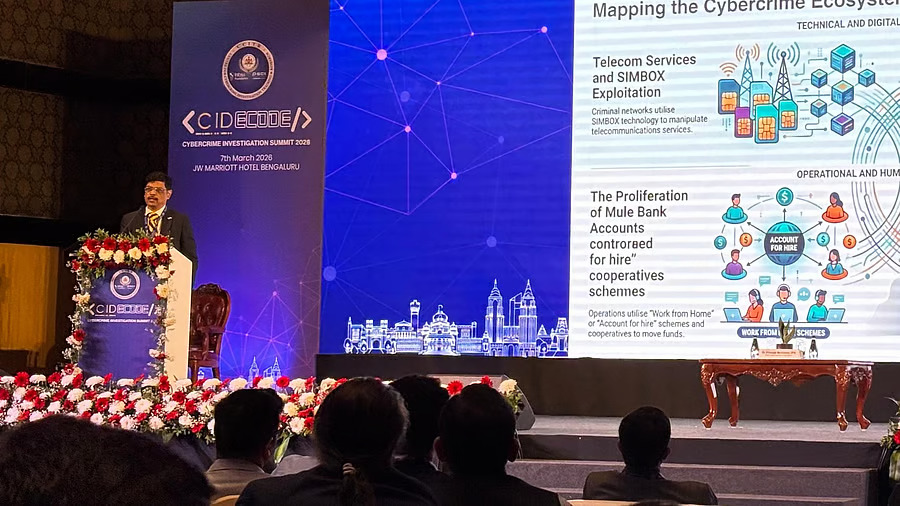
Cybercrime in India has evolved rapidly over the past decade, transforming from simple online fraud into complex international operations that exploit digital technology, social engineering and financial systems. A recent statement by Karnataka’s Director General of Police has drawn attention to a surprising and troubling trend in this evolving landscape. According to the state’s top police official, some of the individuals orchestrating highly sophisticated online frauds are not highly educated technology experts but people with minimal formal education, including individuals who have studied only up to the eighth standard.
The revelation highlights the growing scale and adaptability of cybercriminal networks and underscores the challenges faced by law enforcement agencies trying to keep pace with increasingly complex digital fraud schemes.
Cybercrime Is No Longer Limited to Highly Skilled Hackers
For many years, cybercrime was commonly associated with highly trained programmers or technology specialists capable of breaching secure computer systems. However, law enforcement officials now say that the reality has changed dramatically.
The Karnataka police leadership has observed that many of the people involved in running large-scale online scams have relatively modest educational backgrounds. Despite limited formal schooling, they are able to execute elaborate fraud operations by relying on scripted communication techniques, digital tools and organized criminal networks.
Authorities say this phenomenon demonstrates that modern cybercrime often depends more on manipulation and psychological tactics than on advanced programming skills. Criminal groups use readily available digital platforms, messaging services and financial systems to deceive victims and extract money.
The Emergence of “Pig Butchering” Scams
One of the most alarming forms of fraud currently affecting victims across India is known as the “pig butchering” scam. This term refers to a long-term online deception strategy in which criminals build trust with their targets before persuading them to invest large amounts of money in fake financial opportunities.
The scam operates through a methodical process. Fraudsters first establish contact with victims through social media, messaging platforms or dating apps. They then gradually develop a relationship with the target, often pretending to be successful professionals, investors or romantic partners.
Over time, the criminals introduce the idea of investing in lucrative opportunities such as cryptocurrency trading or foreign exchange markets. The victim is encouraged to start with small investments that appear to generate profits on fake digital dashboards created by the scammers.
Once the victim gains confidence in the supposed investment platform, the fraudsters persuade them to deposit increasingly larger amounts of money. Eventually the scammers disappear, leaving victims with significant financial losses.
Researchers studying such fraud schemes have described the strategy as one where victims are “fattened up” financially before the criminals finally extract as much money as possible.
Organized Networks Behind the Scams
Authorities believe that many of these scams are not carried out by isolated individuals but by organized networks operating across multiple locations. Members of these groups often perform different roles within the operation.
Some individuals are responsible for initiating conversations with potential victims. Others manage the fake investment platforms or handle financial transfers. Still others oversee the laundering of money through complex financial channels.
In many cases, the individuals who communicate directly with victims simply follow prepared scripts. These scripts guide them on how to build trust, respond to questions and encourage victims to invest more money.
Because the process relies heavily on persuasion and emotional manipulation rather than technical expertise, individuals with limited education can still participate effectively in the scam operations.
Technology Has Lowered the Barrier to Cybercrime
Another factor contributing to the rise of such scams is the accessibility of digital technology. Tools that once required advanced knowledge are now widely available and easy to use.
Messaging apps, online payment platforms and social media networks allow criminals to contact potential victims from anywhere in the world. Fraudsters can create convincing online identities using stolen photographs and fabricated personal histories.
Law enforcement officials have also expressed concern about the growing role of emerging technologies such as artificial intelligence and deepfake media in cybercrime. These tools can make fraudulent communications appear more convincing and harder to detect.
For example, deepfake technology can generate realistic images or videos that make fake identities appear authentic. AI-driven chat tools can also help criminals manage large numbers of conversations with potential victims simultaneously.
These technologies are increasingly being integrated into cybercrime strategies, making scams more sophisticated and more difficult for ordinary users to identify.
Victims From All Sections of Society
One of the most troubling aspects of pig butchering scams is that they target a wide range of people across different social and economic backgrounds.
Victims often include professionals, retirees, students and small business owners who may have limited experience with complex financial investments. In many cases, the victims are individuals who are searching for new income opportunities or hoping to grow their savings.
Because the scam relies on building personal relationships and emotional trust, even cautious individuals can fall victim to these schemes. Fraudsters may spend weeks or even months communicating with victims before asking for significant financial investments.
This prolonged interaction makes the deception particularly effective and psychologically damaging.
Law Enforcement Struggles to Keep Pace
The rapid growth of cybercrime has created significant challenges for police agencies around the world. Unlike traditional crimes that occur in physical locations, online fraud often crosses national boundaries and involves complex digital infrastructure.
Tracking down perpetrators requires cooperation between multiple law enforcement agencies, financial institutions and technology companies. Investigators must analyze digital evidence, trace financial transactions and coordinate with international partners.
Even when suspects are identified, recovering stolen money can be extremely difficult because the funds may have been transferred through multiple accounts and converted into digital assets.
Authorities in Karnataka and across India have been strengthening cybercrime units and investing in specialized training to address these challenges.
The Role of Public Awareness
Law enforcement officials emphasize that preventing cybercrime also requires greater public awareness. Since many scams rely on convincing victims to voluntarily transfer money, education and vigilance are essential.
Experts recommend several precautions that individuals can take to protect themselves from online fraud.
People should be cautious about forming relationships with strangers on social media or messaging platforms, especially when those individuals begin discussing investment opportunities. Any online investment platform promising unusually high returns should be treated with skepticism.
It is also important to verify financial information through reliable sources before transferring money or sharing personal data.
If a situation feels suspicious, individuals should consult trusted family members, financial advisors or law enforcement authorities before making financial decisions.
Cybercrime as a Growing National Concern
Cyber fraud has become one of the fastest-growing categories of crime in India. Reports from national cybercrime monitoring systems indicate a steady increase in the number of cases being reported each year.
With the expansion of digital banking, online shopping and smartphone usage, more people than ever are connected to financial systems through the internet. While this digital transformation has created tremendous economic opportunities, it has also provided new avenues for criminal exploitation.
The challenge for governments and law enforcement agencies is to strengthen cybersecurity infrastructure while ensuring that citizens remain informed about potential risks.
The Need for a Multi-Layered Response
Addressing cybercrime requires cooperation across multiple sectors. Technology companies must improve security features and detect fraudulent accounts more effectively. Financial institutions must strengthen monitoring systems to identify suspicious transactions.
Governments must continue investing in cybercrime investigation units and digital forensic capabilities. At the same time, educational campaigns can help citizens recognize common fraud tactics before they become victims.
Experts also emphasize the importance of international collaboration, since many cybercrime networks operate across borders.
Conclusion
The observation by Karnataka’s police leadership that individuals with minimal formal education are capable of running sophisticated cyber scams challenges many assumptions about digital crime. It reveals that modern fraud operations depend less on advanced technical knowledge and more on psychological manipulation, organized networks and accessible technology.
The rise of pig butchering scams demonstrates how criminals exploit trust, emotion and financial ambition to deceive victims. As digital technology continues to evolve, the methods used by cybercriminals are likely to become even more complex.
For society, the lesson is clear. Combating cybercrime will require stronger law enforcement capabilities, improved technological safeguards and, most importantly, a well-informed public capable of recognizing and resisting digital deception.
FACTS Transcripts proudly serves students and professionals across a wide range of regions to support their academic and career goals. Our services are available in:
India
United States
Canada
United Kingdom
New Zealand
Australia
Russia
Middle East
North America
Africa
Our Services – FACTS Transcripts
We at FACTS Transcripts assist in various services, including:
Mark Sheet Transcripts
E-Transcripts
Duplicate Mark Sheets & Degree Certificates
Medium of Instructions Certificates
Attestations
HRD Attestation / Apostille Services
ECA (Educational Credentials Assessment)
Trusted by leading global verification organizations, including WES, IQAS, PEBC, NDEB, NASBA, CAPR, NZQA, ICAS, NCESS, ICES, ECE, eduPASS, ACEI, GCEUS, Comparative Education Services, NNAS, NCA, SAQA, QMAS, FORAC, Australian Pharmacy Council, and more.
FACTS Transcripts – The preferred choice for university document verification worldwide. We ensure a hassle-free process for obtaining your transcripts.