
Myanmar’s journey over the past decade tells a story of hope turned into hardship, democracy cut short, and a country plunged into violent conflict. Once celebrated for tentative steps toward democratic reform, Myanmar has endured one of the most dramatic political reversals in recent Asian history — from fair elections to military takeover, mass protests, civil war, humanitarian crises and contested elections.
At the heart of this decade of turmoil has been a struggle over governance, identity, and the rights of ordinary citizens, set against a backdrop of ethnic diversity and long-standing political fault lines.
The Rise of Democratic Aspirations
In the mid-2010s, Myanmar was widely viewed as a hopeful example of democratic transition. The National League for Democracy (NLD), led by Nobel laureate Aung San Suu Kyi, won a major election in 2015 that ended decades of near-total military dominance.
This victory inspired optimism at home and abroad, as citizens embraced a chance for greater freedom, political participation and economic reforms under a civilian government.
In 2020, the NLD reinforced its popularity with another landslide win in a general election, securing widespread support and hopes of deeper institutional reform.
The Coup That Shattered Democratic Progress
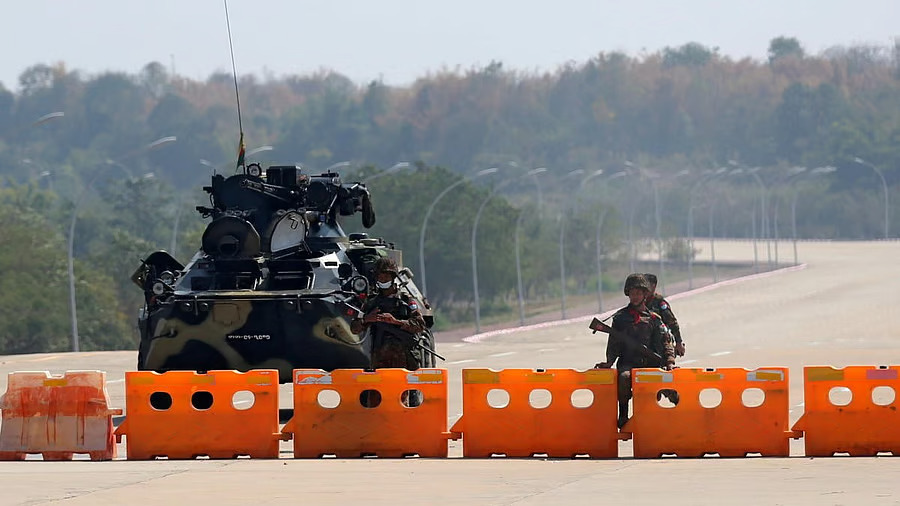
However, the trajectory shifted dramatically on the morning of February 1, 2021. Just as the newly elected parliament was due to convene, Myanmar’s powerful military — known as the Tatmadaw — staged a coup. Top NLD leaders, including Aung San Suu Kyi and President Win Myint, were arrested, and the military declared a state of emergency, seizing control of the government.
The military justified its takeover with unsubstantiated claims of election fraud, a narrative that was rejected by international observers and opposition groups alike. Instead, the coup was seen as a blatant bid by the military to reclaim political dominance after years of losing influence.
Wikipedia
Mass Protests and a Brutal Crackdown
Almost immediately, tens of thousands of people across Myanmar took to the streets in peaceful protest. Yangon, Mandalay, and towns nationwide saw massive demonstrations as citizens from all walks of life — students, workers, monks, and professionals — demanded the restoration of democracy.
But the military responded with overwhelming force. Security forces used live ammunition, rubber bullets, tear gas, and mass arrests to suppress dissent. What began as peaceful rallies soon transformed into something far more dangerous and chaotic.
The crackdown marked a turning point: many protesters, disillusioned by the violence and repression, took up arms to resist the junta. This shift ignited a broader armed conflict and laid the foundation for a full-blown civil war.
Emergence of Armed Resistance and Civil War
As 2021 progressed, many opposition groups formed what became known as the People’s Defence Forces (PDF), coordinating efforts with long-established ethnic armed organisations that had fought for autonomy for decades.
These diverse forces, rooted in ethnic diversity and regional aspirations, posed a significant challenge to junta control. Battles erupted across vast swathes of the country — in mountainous regions, border areas, and contested urban zones — creating one of the world’s most complex internal conflicts.
Civilians were caught in the crossfire, leading to widespread displacement, countless deaths, destruction of infrastructure, and a deepening humanitarian emergency.
Political Repression and Judicial Suppression
While fighting intensified, the junta also tightened its grip through legal and political means. Courts handed heavy prison sentences to Aung San Suu Kyi and other senior NLD figures on a range of charges widely seen as politically motivated.
Later, military authorities dissolved the NLD and dozens of other parties by imposing stringent re-registration rules, further narrowing the space for opposition and political diversity.
Meanwhile, controversial laws were enacted with harsh penalties, including the death sentence, aimed at curbing election disruptions and bolstering junta authority ahead of planned polls.
Humanitarian Crisis and Economic Hardship
The civil war unleashed a severe humanitarian crisis, affecting millions of lives. Armed conflict displaced millions, leaving families without homes, basic services, or stable livelihoods. Economic blockages, global pandemic reverberations and political instability pushed large segments of the population into poverty, chronic hunger, and food insecurity.
International agencies reported millions in need of aid, with acute malnutrition and severe shortages of healthcare, clean water, and shelter becoming daily realities for many.
Natural disasters compounded the crisis. In early 2025, a devastating earthquake struck one of the country’s largest cities, killing thousands, collapsing buildings and worsening an already fragile system of infrastructure. The disaster further exposed the junta’s limitations in responding to emergencies.
Ethnic Armed Groups and Shifting Frontlines
Myanmar’s conflict is not merely a binary struggle between the military and civil protesters; it is deeply interwoven with ethnic resistance movements. Armed groups representing Shan, Kachin, Karenni, Rakhine and other communities took up arms, seeking autonomy, recognition, and protection from decades of marginalization.
Some groups have coordinated major offensives, temporarily taking over strategic towns and territory before counterattacks by the junta. These shifting frontlines and the ever-changing balance of power paint a chaotic picture of protracted war.
Contested Elections Under Military Rule
Even as conflict raged, the junta announced multi-phase general elections scheduled to begin in late December 2025. This marked the first national polls since the 2021 coup. However, the elections were widely criticized as lacking legitimacy.
Major opposition parties, including the once-dominant NLD, are excluded from meaningful participation. Political freedoms are curtailed, and large parts of the country — especially regions not under junta control — could not take part in voting due to safety and accessibility concerns.
International observers, human rights groups and regional actors condemned the polls as a façade intended to legitimize military rule rather than restore democracy. Voter turnout was significantly lower than in previous elections, and the military-aligned party secured a dominant position early in the vote count.
Reuters
These elections could shape Myanmar’s trajectory in the coming years — but they offer little hope for genuine political reconciliation unless substantial changes occur.
Regional and Global Implications
Myanmar’s decade of turmoil has not gone unnoticed by the world. Neighbouring nations, major powers and international organisations have watched closely, each balancing diplomacy, strategic interests and humanitarian concerns.
Some foreign governments have condemned junta actions, while others maintain diplomatic engagement for stability and economic interests. The competing approaches underscore how geopolitics influences responses to human rights and democratic struggles.
The Human Toll: Lives Shattered and Hopes Tested
Behind all the political maneuvering, constitutional disputes and international debates lie the lives of ordinary citizens — families torn apart, children without schools, workers without jobs, and communities living in fear of violence at any moment. Millions have been displaced internally or forced to flee across borders, seeking refuge.
Every statistic reflects human suffering — the loss of loved ones, shattered livelihoods, and futures disrupted indefinitely.
Conclusion: A Nation at a Crossroads
Myanmar’s journey from democratic aspirations to coup and conflict reflects one of the region’s most profound and ongoing crises. A peaceful, inclusive future remains uncertain in a nation where political rights, ethnic identities and freedoms are contested violently and persistently.
FACTS Transcripts proudly serves students and professionals across a wide range of regions to support their academic and career goals. Our services are available in:
India
United States
Canada
United Kingdom
New Zealand
Australia
Russia
Middle East
North America
Africa
Our Services – FACTS Transcripts
We at FACTS Transcripts assist in various services, including:
Mark Sheet Transcripts
E-Transcripts
Duplicate Mark Sheets & Degree Certificates
Medium of Instructions Certificates
Attestations
HRD Attestation / Apostille Services
ECA (Educational Credentials Assessment)
Trusted by leading global verification organizations, including WES, IQAS, PEBC, NDEB, NASBA, CAPR, NZQA, ICAS, NCESS, ICES, ECE, eduPASS, ACEI, GCEUS, Comparative Education Services, NNAS, NCA, SAQA, QMAS, FORAC, Australian Pharmacy Council, and more.
FACTS Transcripts – The preferred choice for university document verification worldwide. We ensure a hassle-free process for obtaining your transcripts.