
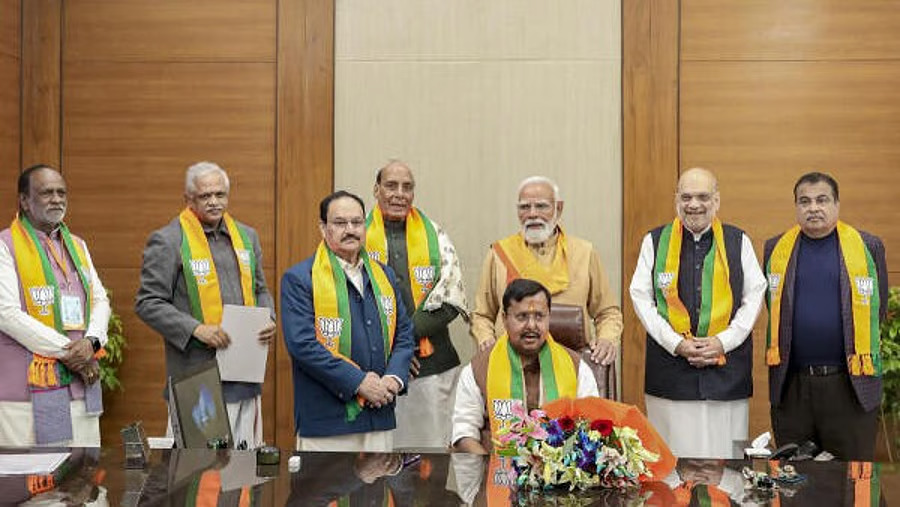
Indian politics witnessed yet another sharp and dramatic confrontation after the Bharatiya Janata Party announced Nitin Nabin as its new national president. While the ruling party projected the move as a decisive and forward-looking leadership transition, the opposition Congress launched a blistering attack, questioning the very process through which the new president was chosen. The controversy has sparked a wider debate on internal party democracy, transparency, and the nature of leadership selection in India’s major political parties.
At the centre of the storm is a simple yet powerful question raised by the Congress leadership: where was the election?
The Appointment That Triggered a Political Clash
Nitin Nabin’s elevation to the post of BJP national president marks a significant generational shift within the party. At a relatively young age, he has been entrusted with leading the world’s largest political party at a time when India’s political landscape is undergoing rapid change. The BJP has described his selection as unanimous, smooth, and reflective of the party’s strong internal cohesion.
According to the ruling party, Nabin’s organisational experience, discipline, and long association with grassroots politics make him a natural choice to steer the party into its next phase. Senior leaders hailed the transition as a sign of stability and continuity, arguing that consensus-based leadership selection has always been part of the party’s organisational culture.
However, what the BJP presented as unity, the Congress described as control.
Congress Questions the Democratic Process
The Congress party reacted with open sarcasm and sharp criticism, accusing the BJP of abandoning democratic norms even within its own internal framework. Senior Congress leaders questioned how a party that regularly speaks about democratic values could appoint its president without a visible, competitive election process.
The opposition mockingly compared the episode to a reality television show, suggesting that leadership roles were being handed out through closed-door decisions rather than through democratic participation. The remark was intended to highlight what Congress claims is a pattern of centralised decision-making within the BJP, where power flows from the top rather than emerging from collective choice.
Congress leaders argued that political parties, especially those in power, must uphold democratic principles not only in public governance but also within their own organisational systems. According to them, the absence of a transparent electoral contest undermines the moral authority of the ruling party to lecture others on democracy.
The Bigger Debate: Consensus vs Competition
The controversy has reopened an old but unresolved debate in Indian politics: should internal party leadership be decided through consensus or through open elections?
Supporters of the BJP argue that consensus-based leadership selection ensures unity, discipline, and efficiency. They claim that internal elections can sometimes create factions, weaken organisational strength, and distract the party from larger political goals. From this perspective, the appointment of Nitin Nabin reflects maturity rather than manipulation.
On the other hand, critics insist that democracy loses meaning when competition is removed entirely. They argue that even internal elections, if symbolic, provide legitimacy, accountability, and a sense of participation among party workers. Without such processes, leadership can appear imposed rather than earned.
The Congress has used this moment to contrast the BJP’s approach with its own recent leadership elections, positioning itself as a party that allows internal debate and contestation. Whether this claim fully matches reality is debated, but the political messaging is clear.
Youth Leadership and Political Optics
One of the BJP’s strongest arguments in defence of Nitin Nabin’s appointment is his age and background. The party has highlighted his rise as evidence of its commitment to nurturing young leadership. In an era where Indian politics is often dominated by veteran figures, the elevation of a younger president is being projected as a message to India’s youth.
However, critics argue that youth representation loses its impact if the process lacks transparency. They claim that leadership renewal should come through democratic competition rather than selection by a small group of senior leaders.
This clash of narratives reflects how political optics matter as much as political reality. The BJP wants the story to be about generational change, while the Congress wants it to be about democratic deficit.
Political Theatre and Media Messaging
The sharp language used by Congress leaders was not accidental. In modern Indian politics, communication strategies often rely on memorable phrases and cultural references to capture public attention. By comparing the leadership appointment to a reality show, the opposition sought to turn a procedural issue into a national talking point.
Such rhetoric highlights how political battles today are fought not only in parliament or on the streets, but also through soundbites, press conferences, and social media narratives. The BJP, meanwhile, responded by maintaining a dignified silence on the sarcasm and focusing instead on projecting unity and organisational strength.
What This Means for Indian Democracy
This episode goes beyond one party and one appointment. It raises important questions about how political organisations function in a democracy as large and complex as India.
If political parties are the foundation of democratic governance, their internal structures matter. Transparency, accountability, and participation within parties influence how power is exercised once those parties form governments. When internal democracy weakens, critics argue, governance itself risks becoming overly centralised.
At the same time, the demand for efficiency, discipline, and electoral success often pushes parties toward tightly controlled leadership models. The tension between these two forces remains unresolved.
Conclusion: A Symbolic Battle With Real Implications
The appointment of Nitin Nabin as BJP president and the Congress’s sharp reaction to it represent more than a routine political disagreement. They reflect competing visions of how power should be organised, exercised, and legitimised in Indian politics.
FACTS Transcripts proudly serves students and professionals across a wide range of regions to support their academic and career goals. Our services are available in:
India
United States
Canada
United Kingdom
New Zealand
Australia
Russia
Middle East
North America
Africa
Our Services – FACTS Transcripts
We at FACTS Transcripts assist in various services, including:
Mark Sheet Transcripts
E-Transcripts
Duplicate Mark Sheets & Degree Certificates
Medium of Instructions Certificates
Attestations
HRD Attestation / Apostille Services
ECA (Educational Credentials Assessment)
Trusted by leading global verification organizations, including WES, IQAS, PEBC, NDEB, NASBA, CAPR, NZQA, ICAS, NCESS, ICES, ECE, eduPASS, ACEI, GCEUS, Comparative Education Services, NNAS, NCA, SAQA, QMAS, FORAC, Australian Pharmacy Council, and more.
FACTS Transcripts – The preferred choice for university document verification worldwide. We ensure a hassle-free process for obtaining your transcripts.