

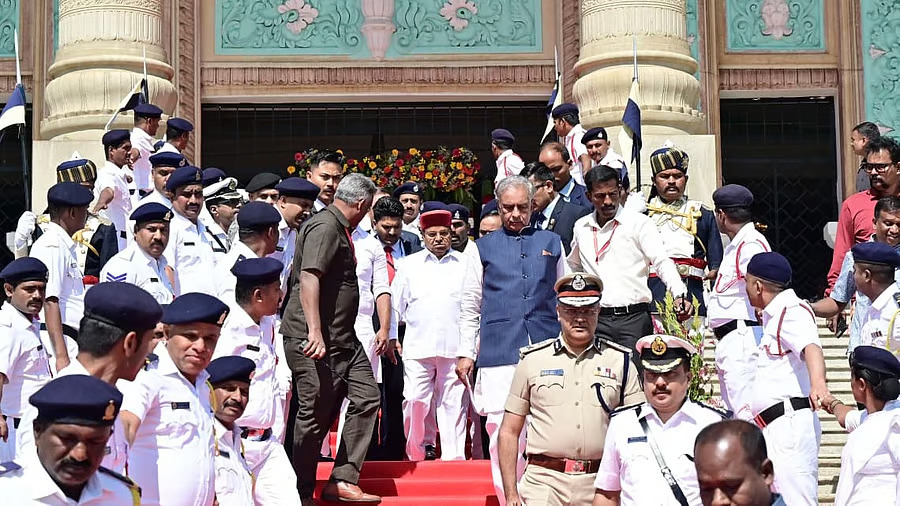
A dramatic and unprecedented political confrontation unfolded in Karnataka on January 22, 2026, when Governor Thaawarchand Gehlot walked out of a joint session of the state legislature without reading the full speech drafted by the elected government. The event triggered furious reactions from leaders of the ruling party, claims of constitutional violations, heated chaos on the assembly floor, and a larger debate on federal norms and institutional roles. What seemed to be a routine legislative address turned into a political flashpoint, illustrating deep faultlines in Indian democracy over constitutional duties, federal balance, and political theatre.
The Context: A Speech, A Standoff, and A Suspenseful Start
At the beginning of the joint session of the Karnataka State Legislature, a customary address was scheduled. Traditionally, the Governor delivers an address prepared by the state cabinet under Article 176 of the Constitution, outlining policy priorities for the coming year. This speech acts as an important ceremonial and political statement, reflecting the government’s agenda as advised by the Council of Ministers.
The controversy erupted when Governor Gehlot refused to read significant portions of the government-drafted speech that reportedly contained critical references to the central government’s policies, specifically the replacement of the Mahatma Gandhi National Rural Employment Guarantee Act (MGNREGA) with the new Viksit Bharat – Guarantee for Rozgar and Ajeevika Mission (Gramin) or “VB-G RAM G” Act. These 11 paragraphs, according to reports, highlighted allegations against the Centre for repealing MGNREGA and weakening labour rights, and also touched upon issues related to tax devolution and funding.
Governor Gehlot objected to these references and demanded deletion or alteration. When an agreement could not be reached, he chose to deliver only a brief, two-line address and exited the legislature, sparking uproar in Vidhana Soudha.
A Political Storm Erupts on the Assembly Floor
As the Governor began to leave after reading a minimal statement about commitment to development, Congress legislators reacted angrily, shouting “shame, shame” and condemning his conduct as disrespectful. Some members — including senior figures like Legislative Council member B.K. Hariprasad — attempted to block the Governor’s path and insisted he complete the full address. A physical scuffle reportedly broke out, resulting in the tearing of Hariprasad’s kurta as marshals and security personnel escorted the Governor out.
The assembly session turned chaotic, with ruling party members accusing the Governor of insulting the democratic process and violating constitutional norms. Congress leaders described the walkout as an affront to the legislature and to the authority of elected representatives.
Siddaramaiah’s Sharp Condemnation: Constitutional Violation
Chief Minister Siddaramaiah was among the most vocal critics of the Governor’s action. He asserted that the Governor had failed in his constitutional duty to read the speech prepared by the state cabinet, thus violating Articles 163 and 176 of the Indian Constitution. According to Siddaramaiah, these constitutional provisions clearly require the Governor to deliver the address advised by the elected government, and not to substitute it with his own speech or abridge it unilaterally.
Siddaramaiah went further, alleging that the Governor had acted as a “puppet” of the central government, implying partisanship rather than impartiality. He described the incident as a “black day” in the state’s democratic history and noted that the government might approach the Supreme Court to seek judicial clarification on the matter.
Other Congress leaders echoed this sentiment, arguing that the Governor’s conduct undermined the dignity of the legislature and the principles of federal governance. They maintained that criticisms of central schemes could not be grounds for rejecting the state government’s policy statement.
Opposition’s Defense: Misuse or Misunderstanding?
In contrast, opposition parties, particularly the Bharatiya Janata Party (BJP), rallied in support of Governor Gehlot’s actions. Senior BJP leaders accused the Congress government of “misusing” the assembly platform to project anti-Centre narratives and stoke public sentiment. They framed the Governor’s refusal to read certain paragraphs as a legitimate stand against politically charged content.
The BJP also contended that the ruling party’s handling of the situation — including attempts to physically block the Governor’s exit and raise confrontational slogans — was inappropriate and worthy of censure. This contrasting narrative illustrates the deep partisan divide over the interpretation of constitutional roles and political strategy.
Constitutional Debate: Expert Views and Legal Ambiguity
Legal and constitutional experts were divided on the interpretation of the Governor’s actions. Some argued that the Governor is constitutionally bound to read the address as prepared by the elected government and that departure from this practice sets a troubling precedent. They stressed that Article 176 requires the Governor to address the legislature on the advice of the council of ministers, making unilateral modification or omission constitutionally questionable.
Others suggested that while the convention is clear, the text of the Constitution leaves room for interpretation in exceptional circumstances, especially where content could be seen as overtly political or contentious. These experts cautioned against drawing rigid conclusions without legal scrutiny, noting that several similar standoffs in other states — such as in Tamil Nadu and Kerala — have complicated the issue.
One opinion raised was that incidents like this underscore a deeper systemic ambiguity about the balance between constitutional conventions and discretionary power of the Governor. Recommendations were also made for considering a constitutional amendment to clarify the scope of the Governor’s role in delivering addresses and handling contentions.
Comparative Context: Governors in Other States
The events in Karnataka did not occur in isolation. Similar episodes in other states, including Tamil Nadu and Kerala, where Governors have either walked out or altered portions of their addresses, highlight a broader pattern of tensions between state governments and Governors appointed by the Centre. These confrontations underscore recurring questions over the extent of gubernatorial discretion and the role of Governors in federal governance.
This broader context suggests that the Karnataka incident is part of a larger systemic challenge in Indian federal politics, where ceremonial offices intersect with deep partisan conflicts and competing narratives about governance and constitutional propriety.
Implications for Federalism and Democratic Norms
The controversy has profound implications for how India’s constitutional framework functions in practice. It calls attention to several key issues:
Federal Balance: The episode underscores tensions in federal relations between the elected state government and the centrally appointed Governor, raising questions about the appropriate boundaries of gubernatorial intervention in legislative processes.
Institutional Norms: The confrontation highlights the need to clarify institutional conventions and constitutional duties, particularly in politically sensitive contexts where ceremonial roles overlap with political contentions.
Public Perception: High-profile clashes of this nature shape public perceptions of constitutional institutions. When elected leaders and Governors engage in public disputes, it can either deepen confidence in democratic accountability or fuel cynicism about political motivations, depending on how events are interpreted.
Legal Precedents: Possible legal challenges to the walkout, including a potential appeal to the Supreme Court, could establish important precedents that clarify the constitutional obligations of Governors and the limits of discretionary power.
The Political Landscape Ahead
As Karnataka moves forward, the fallout from this incident is likely to shape political discourse in the state for weeks and months. The ruling party’s portrayal of the walkout as a breach of democratic norms will resonate with its supporters, while opposition arguments about political misuse will strengthen their critique of the government’s tactics. If the matter progresses legally, the judicial interpretation could influence future state-centre interactions across India.
In a broader sense, this confrontation reflects the complex dynamics of Indian democracy, where constitutional conventions, political strategy, and institutional roles are continuously negotiated in the public arena. It raises vital questions about how democratic processes should function when ceremonial duties intersect with political disagreement.
FACTS Transcripts proudly serves students and professionals across a wide range of regions to support their academic and career goals. Our services are available in:
India
United States
Canada
United Kingdom
New Zealand
Australia
Russia
Middle East
North America
Africa
Our Services – FACTS Transcripts
We at FACTS Transcripts assist in various services, including:
Mark Sheet Transcripts
E-Transcripts
Duplicate Mark Sheets & Degree Certificates
Medium of Instructions Certificates
Attestations
HRD Attestation / Apostille Services
ECA (Educational Credentials Assessment)
Trusted by leading global verification organizations, including WES, IQAS, PEBC, NDEB, NASBA, CAPR, NZQA, ICAS, NCESS, ICES, ECE, eduPASS, ACEI, GCEUS, Comparative Education Services, NNAS, NCA, SAQA, QMAS, FORAC, Australian Pharmacy Council, and more.
FACTS Transcripts – The preferred choice for university document verification worldwide. We ensure a hassle-free process for obtaining your transcripts.