
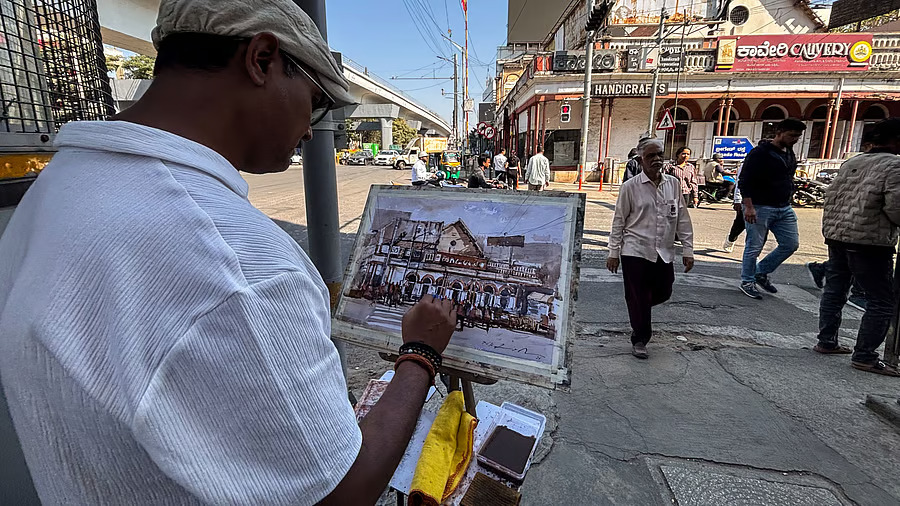
In the bustling urban landscape of Bengaluru, where tech parks and skyscrapers often attract most of the attention, one artist has chosen a different kind of canvas: the city’s historic architecture and timeless buildings. In a project that has begun gaining attention, an artist is painting these structures in watercolours, without the use of digital filters or artificial intelligence — relying purely on paint, brush and observation. This series — part of his larger project titled “India on My Easel” — aims to capture 100 historic buildings of the city and, later on, the people who live and work in and around these places. What makes this artistic endeavour special is that it invites residents and visitors alike to see Bengaluru through a fresh lens — one that honours heritage, beauty and the everyday life of the city as lived by its people.
Rediscovering Bengaluru’s Architectural Soul
Bengaluru isn’t just India’s technology capital; it is also a city with layers of history that stretch back hundreds of years, evolving through different eras — from pre‑colonial rule to the colonial era and into independent India. Many of its older buildings tell stories of civic life, religious expression and community history. Structures like Halasuru Someshwara Temple — a Shiva temple dating back to the period of the Chola and Vijayanagara empires — are physical reminders of the city’s historical roots long before it became a modern metropolis.
Other venerable sites include St. John’s Church, built in the 1850s in Gothic style and standing as one of the oldest Protestant churches in Bengaluru, and St. Mark’s Cathedral, a Baroque‑inspired cathedral over two centuries old. These buildings — each with its own architectural language — represent eras and influences that modern architecture often overshadows.
For many residents, such structures are familiar but taken for granted. They appear almost as background noise in the city’s dynamic life. Painting them in rich watercolours brings them to the foreground again, urging the viewer to pause, reflect and appreciate details often lost amid the city’s rapid transformation.
The Artist’s Vision: From Buildings to People
What makes this series exciting is not just the buildings themselves, but the artist’s evolving vision. The creator plans to move beyond architecture to portray the regular people who occupy these spaces. This means capturing not just shiny facades but the human stories connected to them — street vendors outside a historic market, children playing near an old civic building, students resting against a temple wall. This evolution gives the project emotional depth and connects architecture with lived experience, reminding us that cities are not only shaped by stone and mortar but also by the people who animate them.
This idea — pairing places with people — elevates the project from architectural documentation to urban storytelling. Each painting becomes a narrative moment, chronicling a slice of life that ties the city’s past into its present.
Watercolour as a Medium of Memory and Emotion
Watercolour, as a medium, carries a special resonance for depicting urban heritage. Unlike oils or digital art, watercolours allow for a soft interplay of light and shade, giving buildings a luminous, almost dreamlike quality. The medium captures the fleeting impressions of morning sun against old brick, or the rich hues of fading walls — evoking emotion as much as visual detail.
Watercolour’s delicacy also mirrors the fragility of heritage architecture in a city like Bengaluru, where historic sites face pressures from infrastructure growth and real‑estate development. Through his art, the creator not only celebrates these buildings but also quietly asserts their importance in the cultural memory of the city.
Art That Bridges Past and Present
Bengaluru’s history is complex. It stretches from early settlements through the reign of regional empires, into colonial influence and on to post‑independence urbanization. Yet for many years, heritage awareness has balanced uneasily with the city’s rapid technological and residential expansion. Urban planning debates often focus on transportation, water supply, housing and economic growth, but art like this brings architecture and heritage back into the conversation.
Exhibitions — whether in galleries, public spaces, online or in community events — help residents reconsider what makes the city meaningful. Paintings can act as cultural bridges, connecting those who have lived in the city for generations with newcomers curious about local history and identity.
In Bengaluru there are other creative efforts that similarly invite cultural engagement. Postcard collections depicting old Bangalore scenes, for example, remind people of how much the city has changed and what has endured from the past. The watercolour series aligns with this broader cultural impulse to preserve memory through artistic expression.
Why This Matters to Bengaluru
Many cities around the world strive to balance tradition with modernity, and Bengaluru is no exception. Called the Silicon Valley of India for its booming information technology sector, the city is also a place where leafy parks, lakes, temples and colonial edifices stand beside gleaming corporate campuses. Projects like “India on My Easel” provide an artistic counterpoint to fast‑paced urban life, encouraging citizens to notice, value and reflect on their surroundings as living heritage.
For residents, seeing familiar buildings portrayed with affection and care can spark pride, nostalgia and curiosity. For visitors, it offers an artistic lens through which the city’s multi‑layered identity becomes more accessible and engaging.
Art That Invites Community Participation
One of the most inspiring aspects of the series is the possibility that it might encourage others to engage in creative documentation of their environment. Art exhibitions, collaborative public murals, heritage walks and workshops all contribute to a culture of appreciation, where citizens become active participants in capturing and preserving local stories.
For example, cultural organisations and theatre groups in Bengaluru have long worked to promote local artistic expression, strengthening community bonds through performance and storytelling. Similarly, group exhibitions and art walks can bring diverse audiences into conversation about what the city’s identity means — historically, socially and emotionally.
Looking Forward: A Hundred Buildings and Beyond
The goal of painting 100 historic buildings is ambitious and inspiring. Each completed painting is a visual tribute to the city’s architectural heritage and the human experiences those structures continue to host. As the project progresses, it will create not only a gallery of beautiful watercolour works but also a visual archive that future generations can refer to and cherish.
It’s a reminder that art isn’t just decoration — it is a means of storytelling that preserves memory, ignites emotional connection, and invites audiences to look more deeply at the world around them.
FACTS Transcripts proudly serves students and professionals across a wide range of regions to support their academic and career goals. Our services are available in:
India
United States
Canada
United Kingdom
New Zealand
Australia
Russia
Middle East
North America
Africa
Our Services – FACTS Transcripts
We at FACTS Transcripts assist in various services, including:
Mark Sheet Transcripts
E-Transcripts
Duplicate Mark Sheets & Degree Certificates
Medium of Instructions Certificates
Attestations
HRD Attestation / Apostille Services
ECA (Educational Credentials Assessment)
Trusted by leading global verification organizations, including WES, IQAS, PEBC, NDEB, NASBA, CAPR, NZQA, ICAS, NCESS, ICES, ECE, eduPASS, ACEI, GCEUS, Comparative Education Services, NNAS, NCA, SAQA, QMAS, FORAC, Australian Pharmacy Council, and more.
FACTS Transcripts – The preferred choice for university document verification worldwide. We ensure a hassle-free process for obtaining your transcripts.