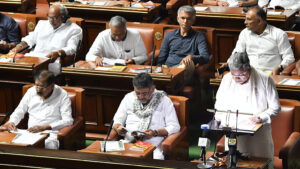

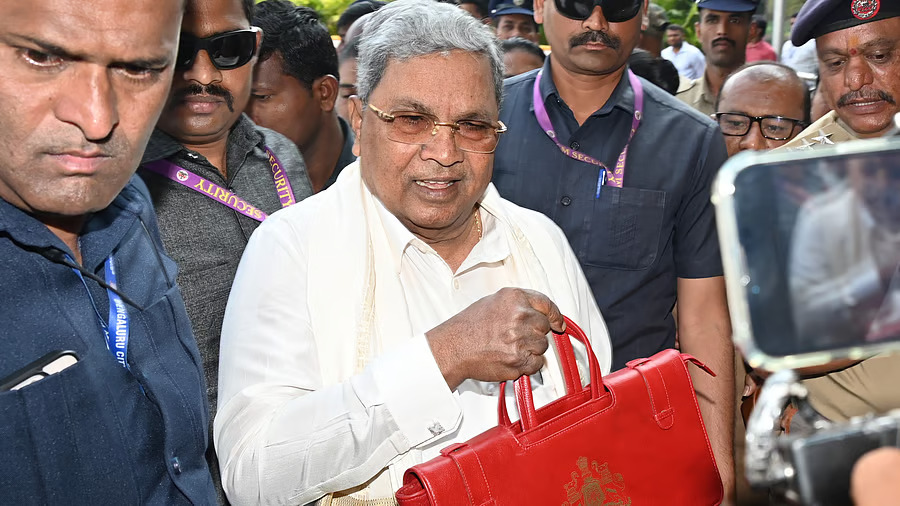
The presentation of the latest Karnataka state budget turned into a political and economic debate after Chief Minister Siddaramaiah used an unusual historical reference from the epic Mahabharata to explain the state’s financial challenges. While presenting the budget for the 2026–27 financial year, the chief minister argued that the state government is functioning under significant fiscal constraints, many of which he believes stem from the policies and financial arrangements imposed by the central government.
His speech did not merely list financial allocations and welfare schemes. Instead, it attempted to frame the budget within a broader narrative about federal relations, economic responsibilities and the political dynamics between the state and the Union government. By invoking the figure of Bhishma, Siddaramaiah sought to illustrate the principle that those who contribute significantly to a system must also be supported adequately if the entire system is to remain stable.
A Symbolic Reference to Bhishma
During the speech, the chief minister referred to a philosophical idea associated with Bhishma from the Mahabharata. The analogy was meant to highlight the importance of caring for productive resources. According to the interpretation he presented, a cow that produces abundant milk must be properly nourished and protected; otherwise the entire community dependent on it will suffer.
Siddaramaiah used this metaphor to describe Karnataka’s role in India’s economy. The state, he said, contributes heavily to national tax revenues and plays a central role in sectors such as technology, manufacturing, services and innovation. However, he argued that the financial returns and fiscal flexibility provided to the state do not match its contributions.
Through this analogy, the chief minister attempted to underline what he described as a structural imbalance in fiscal federalism. The message was that states which generate significant economic output should receive adequate financial support and policy flexibility from the central government.
The Context of the 2026–27 Budget
The budget presented by Siddaramaiah is significant for several reasons. It marks the seventeenth budget he has presented in his political career, an unusually high number for any state leader. The total expenditure proposed for the 2026–27 financial year is estimated at approximately ₹4.48 lakh crore, reflecting the scale of public spending required to sustain development and welfare programmes across the state.
The budget arrives at a time when Karnataka is trying to maintain high economic growth while also expanding social welfare commitments. According to official figures cited during the presentation, the state’s economy recorded real growth of around 8.1 percent in 2025–26, which was higher than the national growth rate during the same period.
This growth has been driven by strong performance in sectors such as information technology, services, manufacturing and start-up innovation. Cities like Bengaluru continue to attract global technology investments and remain central to India’s digital economy.
Despite these economic achievements, the state government says it faces significant fiscal limitations.
The Fiscal Strain Argument
One of the main themes of the budget speech was the claim that changes in national tax policies and revenue sharing arrangements have affected the finances of the state.
Siddaramaiah pointed out that modifications in the structure of the Goods and Services Tax have reduced the state’s revenue potential. According to his statement, rationalisation of GST rates resulted in a revenue loss of nearly ₹10,000 crore for Karnataka during the current fiscal year, with an even larger loss expected in the next financial cycle.
This reduction, he argued, has made it more difficult for the state to fund large welfare programmes and development projects while maintaining fiscal discipline.
Another factor mentioned in the discussion is the limited taxation power available to states after the implementation of GST. Because many indirect taxes are now controlled centrally through the GST framework, states have fewer independent options to increase revenue when expenditure rises.
Welfare Commitments and Public Spending
The budget also reflects the political priorities of the ruling government. Since returning to power, the administration has emphasised social welfare programmes designed to support lower-income households, women and youth.
These programmes require substantial financial allocations. As a result, the government must balance two competing priorities: maintaining welfare commitments while keeping fiscal deficits within acceptable limits under financial responsibility regulations.
The chief minister argued that despite these challenges, the government has attempted to maintain fiscal discipline while continuing to invest in development projects and social welfare schemes.
Development Initiatives Across the State
Beyond the political debate, the budget also includes a range of development initiatives aimed at different regions of Karnataka. These include investments in infrastructure, education, agriculture, industrial development and healthcare.
Several programmes focus on the development of northern districts of the state, often referred to as Kittur Karnataka. Plans include industrial corridors, technology innovation centres and educational infrastructure designed to stimulate regional growth and create employment opportunities.
Among the proposed initiatives are industrial nodes connected to the Bengaluru–Mumbai economic corridor, digital learning programmes for students and specialised healthcare facilities in various districts.
The budget also includes proposals for new infrastructure such as colleges, research centres and training facilities intended to boost regional economic activity.
Political Reactions and Criticism
As expected, the budget has triggered political reactions from opposition leaders and central government representatives. Critics have argued that the state government is relying heavily on borrowing and that the budget does not provide a clear long-term strategy for debt management.
Some opposition figures have described the financial plan as overly dependent on loans, claiming that future governments could face difficulties if revenue projections do not materialise.
Supporters of the government, however, argue that welfare spending and infrastructure investments are necessary to sustain economic growth and reduce inequality.
The Broader Federal Debate
The controversy surrounding the budget reflects a broader debate about fiscal federalism in India. Many state governments across the country have raised concerns about their financial autonomy after the introduction of GST and changes in tax-sharing formulas.
States argue that while they are responsible for implementing many welfare programmes and development projects, their ability to raise revenue independently has become more limited. This tension has led to recurring disagreements between state governments and the Union government over financial allocations and policy decisions.
Karnataka’s case has gained particular attention because of the state’s economic importance. As one of the largest contributors to national tax revenues and a major hub for technology and industry, its financial policies often influence wider debates about economic governance in India.
Economic Growth and Future Prospects
Despite the fiscal disputes, Karnataka remains one of India’s most dynamic economies. The state has consistently ranked among the top contributors to the national economy, with strong performance in manufacturing, services, agriculture and the technology sector.
Bengaluru’s global reputation as an innovation hub continues to attract multinational companies, start-ups and venture capital investment. This ecosystem contributes significantly to employment generation and export revenues.
The government believes that sustained investments in infrastructure, education and technology will help maintain this growth trajectory in the coming years.
A Budget Framed by Political Messaging
The use of a Mahabharata reference in a budget speech illustrates how political communication often merges cultural symbolism with economic arguments. By invoking Bhishma’s philosophy, Siddaramaiah attempted to present Karnataka as a vital contributor to the nation’s economic prosperity that deserves greater financial support.
Whether this narrative convinces critics or not, it highlights the increasingly complex relationship between state finances, national economic policies and political messaging.
The budget itself is therefore more than a financial document. It is also a statement about the state’s priorities, its economic ambitions and its ongoing negotiation with the central government over resources and authority.
Conclusion
The latest Karnataka budget reflects both the opportunities and challenges facing one of India’s most economically significant states. While the government points to strong growth and ambitious development programmes, it also emphasises the fiscal pressures it attributes to national policy frameworks.
By combining economic statistics with historical symbolism, Siddaramaiah attempted to frame the debate in broader philosophical and political terms. The coming months will reveal how effectively the government can implement its proposals while managing the fiscal constraints that have become central to the current political discourse in Karnataka.
FACTS Transcripts proudly serves students and professionals across a wide range of regions to support their academic and career goals. Our services are available in:
India
United States
Canada
United Kingdom
New Zealand
Australia
Russia
Middle East
North America
Africa
Our Services – FACTS Transcripts
We at FACTS Transcripts assist in various services, including:
Mark Sheet Transcripts
E-Transcripts
Duplicate Mark Sheets & Degree Certificates
Medium of Instructions Certificates
Attestations
HRD Attestation / Apostille Services
ECA (Educational Credentials Assessment)
Trusted by leading global verification organizations, including WES, IQAS, PEBC, NDEB, NASBA, CAPR, NZQA, ICAS, NCESS, ICES, ECE, eduPASS, ACEI, GCEUS, Comparative Education Services, NNAS, NCA, SAQA, QMAS, FORAC, Australian Pharmacy Council, and more.
FACTS Transcripts – The preferred choice for university document verification worldwide. We ensure a hassle-free process for obtaining your transcripts