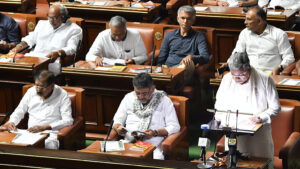


The Karnataka government has announced a major and unprecedented policy decision that could significantly reshape how children interact with the digital world. During the presentation of the State Budget for the financial year 2026–27, Chief Minister Siddaramaiah declared that the use of social media platforms will be banned for children below the age of sixteen in the state. This announcement has triggered widespread discussions across India about digital safety, mental health, and the responsibilities of governments, parents, and technology companies in protecting young users.
This decision places Karnataka among the first regions in India to propose such strict regulation on minors’ access to social media platforms. The move reflects growing concerns about the influence of smartphones, online platforms, and digital content on the emotional and psychological development of children. With the state being home to Bengaluru, often called the country’s technology capital, the policy carries particular significance as it emerges from one of India’s most digitally connected regions.
The announcement was made while presenting the state budget in the legislative assembly, which outlined several initiatives related to infrastructure, technology, welfare programmes, and education. Among the many proposals, the decision to restrict social media access for children stood out as one of the most discussed and debated policy measures.
The government stated that the primary goal behind the proposed ban is to protect children from the harmful effects of excessive mobile phone usage and social media exposure. Increasing screen time among young people has become a serious concern across the world, with educators, psychologists, and policymakers warning that prolonged use of digital platforms may affect concentration, academic performance, and emotional well-being.
According to the Chief Minister, the rapid rise of smartphones and social networking applications has transformed the lifestyle of children in recent years. Many students spend hours scrolling through online platforms, often at the cost of physical activity, social interaction, and academic focus. The government believes that limiting access to these platforms at an early age could help encourage healthier habits and improve overall development among school-going children.
Experts have also raised concerns about cyberbullying, exposure to inappropriate content, and privacy risks faced by minors on digital platforms. Children and teenagers are particularly vulnerable to online manipulation, misinformation, and psychological pressures created by social media culture. These issues have been repeatedly highlighted by educators and parents across the state, leading to increasing calls for stronger regulation.
The proposed restriction would apply to major social media platforms used globally, including those that allow users to create profiles, share content, and interact through comments, messages, and multimedia posts. The government has not yet provided detailed information on how the rule will be implemented, but it is expected that mechanisms such as age verification systems, parental controls, and platform-level restrictions may be introduced.
While the proposal has been welcomed by some parents and educators, it has also sparked debate among technology experts and digital rights advocates. Critics argue that completely banning social media for young users could be difficult to enforce in practice, as many teenagers may bypass restrictions by using false age details or accessing platforms through alternative channels. Others believe that instead of bans, governments should focus on digital education and awareness programmes that teach children how to use the internet responsibly.
Technology companies have also reacted cautiously to the announcement. Some industry representatives have warned that strict bans might push teenagers toward unregulated or less secure online spaces where safety controls are weaker. These companies argue that collaboration between governments, parents, and platform providers could be more effective in ensuring safe digital experiences for young users.
Despite the debate, the Karnataka government maintains that the policy is designed with the welfare of children as its central objective. Officials believe that limiting early exposure to social media could help reduce digital addiction and promote healthier childhood development. If implemented successfully, the initiative could serve as a model for other Indian states that are also exploring similar regulations on digital platforms.
The policy announcement is part of a much larger state budget with an overall outlay of approximately ₹4.48 lakh crore. The budget includes major investments in infrastructure, technology innovation, education, and social welfare programmes. Among the key initiatives are plans to strengthen public education systems, expand transportation networks, and promote technological research and development within the state.
One notable technology initiative announced in the budget involves the establishment of a robotics and artificial intelligence innovation zone in collaboration with scientific institutions and research organizations. The state government aims to position Karnataka as a global hub for advanced technology and innovation while simultaneously ensuring that digital growth remains socially responsible and inclusive.
At the same time, the budget outlines investments in school infrastructure, teacher recruitment, and educational facilities to improve learning environments across government institutions. By focusing on both technology and education reforms, the state hopes to create a balanced ecosystem where innovation and social well-being develop together.
The proposal to restrict social media access for children reflects a broader global trend where governments are increasingly examining the impact of digital technology on young people. Countries around the world have begun discussing age restrictions, parental control frameworks, and digital literacy programmes to address concerns about online safety and mental health.
In India, the debate over children’s digital exposure has gained momentum as internet penetration continues to rise rapidly. With the country having one of the largest social media user bases in the world, policymakers are facing the challenge of balancing technological freedom with the protection of vulnerable users.
The Karnataka initiative could therefore mark the beginning of a wider national conversation about how children should interact with technology in the modern age. While the exact framework of the ban is yet to be clarified, the policy has already sparked discussions among educators, parents, policymakers, and technology companies about the future of digital regulation.
For students and families, the announcement serves as a reminder of the importance of responsible technology usage. While social media offers opportunities for communication, learning, and creativity, excessive or uncontrolled use can also lead to serious challenges for young users.
As Karnataka moves forward with its proposal, the coming months will likely see detailed guidelines, consultations with technology companies, and discussions about implementation strategies. Whether the policy becomes a model for other states or evolves into a broader national regulation remains to be seen.
The decision represents a significant moment in India’s digital policy landscape. By prioritizing the well-being of children and acknowledging the complex relationship between technology and society, the state government has initiated an important dialogue about how digital platforms should be used responsibly in the years ahead.
In a rapidly evolving digital era, such measures highlight the growing recognition that technological progress must be accompanied by thoughtful policies that safeguard the next generation.
FACTS Transcripts proudly serves students and professionals across a wide range of regions to support their academic and career goals. Our services are available in:
India
United States
Canada
United Kingdom
New Zealand
Australia
Russia
Middle East
North America
Africa
Our Services – FACTS Transcripts
We at FACTS Transcripts assist in various services, including:
Mark Sheet Transcripts
E-Transcripts
Duplicate Mark Sheets & Degree Certificates
Medium of Instructions Certificates
Attestations
HRD Attestation / Apostille Services
ECA (Educational Credentials Assessment)
Trusted by leading global verification organizations, including WES, IQAS, PEBC, NDEB, NASBA, CAPR, NZQA, ICAS, NCESS, ICES, ECE, eduPASS, ACEI, GCEUS, Comparative Education Services, NNAS, NCA, SAQA, QMAS, FORAC, Australian Pharmacy Council, and more.
FACTS Transcripts – The preferred choice for university document verification worldwide. We ensure a hassle-free process for obtaining your transcripts.