

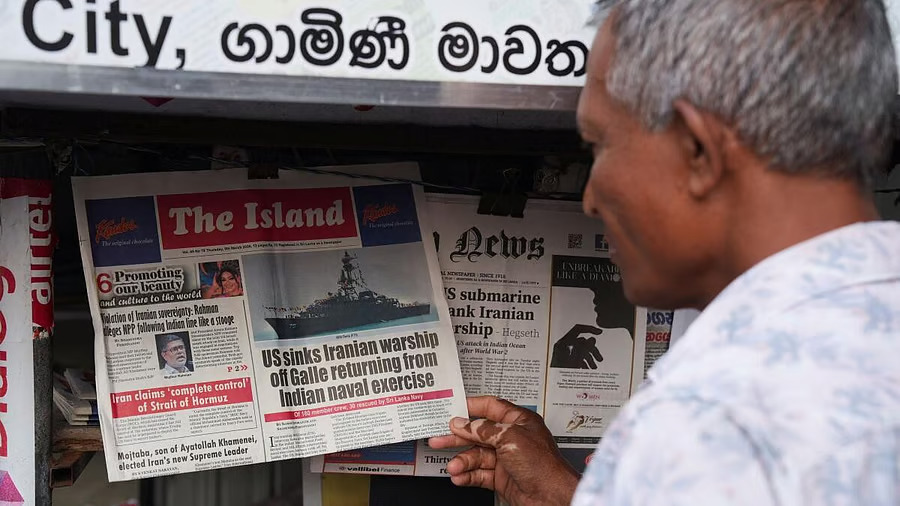
The geopolitical tensions that erupted across West Asia have now begun to affect the waters of the Indian Ocean. Sri Lanka recently confirmed that a second Iranian ship is waiting near its maritime boundary and has requested permission to enter the country’s territorial waters. The situation has drawn significant attention from regional observers, as Colombo evaluates its next steps carefully in order to protect human lives while maintaining regional stability.
Officials in Sri Lanka stated that the government is closely monitoring the developments and is considering possible actions that would ensure the safety of the crew on board the vessel while also preserving peace in the region. The announcement came amid heightened tensions following a deadly naval incident involving an Iranian warship near Sri Lanka’s southern coast.
Background: Naval Incident Off Sri Lanka’s Coast
The unfolding situation is linked to a major maritime incident that occurred in the Indian Ocean just days earlier. An Iranian naval frigate known as the IRIS Dena was sunk near the southern Sri Lankan coastal city of Galle after being struck by a torpedo fired from a United States submarine. The attack took place in international waters roughly forty nautical miles from Sri Lanka’s coast.
The sinking of the warship resulted in heavy casualties among the crew. Sri Lankan rescue teams rushed to the scene after receiving distress signals from the vessel. Authorities managed to rescue several sailors and transport them to hospitals for treatment, while many others were confirmed dead and some remained missing.
The naval strike was widely seen as part of the escalating confrontation involving Iran, the United States, and their respective allies. Analysts have described the event as one of the most significant maritime clashes in the region in recent years.
Discovery of a Second Iranian Vessel
In the aftermath of the sinking, Sri Lankan authorities detected another Iranian vessel operating close to the island’s maritime zone. According to officials in Colombo, the ship is currently located in Sri Lanka’s Extended Economic Zone and is waiting outside the country’s territorial waters. The vessel reportedly requested permission to enter the waters for assistance.
Government spokesperson and minister Nalinda Jayatissa informed parliament that the authorities are fully aware of the situation and are evaluating their options. He emphasized that Sri Lanka’s primary objective is to safeguard the lives of those on board the vessel while ensuring that the country does not become directly involved in the larger geopolitical confrontation unfolding in the region.
Officials indicated that the government is intervening diplomatically and operationally to prevent further escalation and to maintain maritime stability around the island nation.
Humanitarian Concerns and Rescue Efforts
Humanitarian considerations have become a major factor in Sri Lanka’s response. The government has expressed concern for the safety of the crew members aboard the Iranian vessel. Authorities have indicated that they are prepared to provide assistance if necessary, especially if the ship is experiencing technical difficulties or medical emergencies.
Following the earlier naval attack, survivors from the sunken warship were transported to hospitals in southern Sri Lanka where they received medical treatment. Doctors reported that many of the injuries sustained by the rescued sailors were not life-threatening, although several individuals required close monitoring.
Sri Lankan naval and medical teams have continued to coordinate recovery operations, including the identification and repatriation of deceased sailors.
Sri Lanka’s Strategic Dilemma
The presence of a second Iranian ship near Sri Lanka has placed the government in a sensitive position. As a strategically located island nation in the Indian Ocean, Sri Lanka often serves as an important maritime crossroads for international shipping and naval activity.
At the same time, the country seeks to maintain neutrality and avoid being drawn into major power rivalries. Allowing a foreign military vessel to enter its waters during a time of conflict could have diplomatic consequences, particularly given the broader tensions between Iran and Western powers.
For this reason, Sri Lankan authorities are carefully weighing humanitarian obligations against security and diplomatic considerations. The government has emphasized that any decision will prioritize the protection of lives and the preservation of regional peace.
Regional Security Concerns
The events unfolding near Sri Lanka highlight how conflicts in distant regions can quickly spread into new geographical areas. The Indian Ocean has long been a crucial route for international trade, energy transportation, and naval operations. Any instability in these waters could affect global shipping lanes and economic activity.
Security experts warn that continued escalation between Iran and its adversaries could lead to additional incidents at sea. Naval forces from several countries operate in the region, and the presence of military vessels from opposing sides increases the risk of confrontation.
Sri Lanka’s geographic location makes it particularly vulnerable to such developments. The island nation sits along major maritime routes connecting the Middle East, Asia, and Africa, meaning that regional conflicts often have direct implications for its security environment.
Diplomatic Efforts to Maintain Stability
In response to the situation, Sri Lanka has emphasized diplomacy and humanitarian responsibility. Government officials have reiterated that their country does not wish to take sides in the conflict but instead aims to prevent further loss of life.
Authorities are working to communicate with relevant parties and international organizations to manage the situation responsibly. The goal is to provide necessary assistance to those in distress while ensuring that Sri Lanka’s territory and waters are not used in ways that could escalate tensions.
This cautious approach reflects Sri Lanka’s broader foreign policy, which prioritizes neutrality and cooperation with multiple international partners.
Wider Implications for Global Maritime Security
The developments near Sri Lanka illustrate how regional conflicts can have ripple effects across global maritime networks. Naval incidents not only threaten the safety of sailors but also create uncertainty for international shipping companies and commercial vessels operating in nearby waters.
If tensions continue to rise, countries across the Indian Ocean region may need to strengthen coordination on maritime security and emergency response mechanisms.
For Sri Lanka, the immediate focus remains on managing the humanitarian and diplomatic dimensions of the Iranian ship situation. The government’s response in the coming days will likely shape how the crisis evolves and how the international community perceives the island nation’s role in maintaining peace in the region.
Conclusion
The appearance of a second Iranian ship near Sri Lanka’s maritime boundary has added a new layer of complexity to an already volatile international situation. As Colombo deliberates its response, the country finds itself balancing humanitarian responsibility, national security, and diplomatic neutrality.
The sinking of the Iranian frigate and the subsequent arrival of another vessel underscore the growing impact of global geopolitical tensions on the Indian Ocean region. Sri Lanka’s careful and measured approach demonstrates its determination to protect lives while preventing the crisis from expanding further.
FACTS Transcripts proudly serves students and professionals across a wide range of regions to support their academic and career goals. Our services are available in:
India
United States
Canada
United Kingdom
New Zealand
Australia
Russia
Middle East
North America
Africa
Our Services – FACTS Transcripts
We at FACTS Transcripts assist in various services, including:
Mark Sheet Transcripts
E-Transcripts
Duplicate Mark Sheets & Degree Certificates
Medium of Instructions Certificates
Attestations
HRD Attestation / Apostille Services
ECA (Educational Credentials Assessment)
Trusted by leading global verification organizations, including WES, IQAS, PEBC, NDEB, NASBA, CAPR, NZQA, ICAS, NCESS, ICES, ECE, eduPASS, ACEI, GCEUS, Comparative Education Services, NNAS, NCA, SAQA, QMAS, FORAC, Australian Pharmacy Council, and more.
FACTS Transcripts – The preferred choice for university document verification worldwide. We ensure a hassle-free process for obtaining your transcripts.
FACTS Transcripts proudly serves students and professionals across a wide range of regions to support their academic and career goals. Our services are available in:
India
United States
Canada
United Kingdom
New Zealand
Australia
Russia
Middle East
North America
Africa
Our Services – FACTS Transcripts
We at FACTS Transcripts assist in various services, including:
Mark Sheet Transcripts
E-Transcripts
Duplicate Mark Sheets & Degree Certificates
Medium of Instructions Certificates
Attestations
HRD Attestation / Apostille Services
ECA (Educational Credentials Assessment)
Trusted by leading global verification organizations, including WES, IQAS, PEBC, NDEB, NASBA, CAPR, NZQA, ICAS, NCESS, ICES, ECE, eduPASS, ACEI, GCEUS, Comparative Education Services, NNAS, NCA, SAQA, QMAS, FORAC, Australian Pharmacy Council, and more.
FACTS Transcripts – The preferred choice for university document verification worldwide. We ensure a hassle-free process for obtaining your transcripts.