
In January 2026, Karnataka witnessed intense political drama that has captured headlines and stirred debate across the state and beyond. What began with a routine joint session of the state legislature quickly escalated into a high-stakes confrontation between the state government and the Raj Bhavan, resulting in protests, slogans against the Governor, and sharp political commentary from leaders across parties. At the center of this turmoil was the slogan “Go Back Governor,” aimed at the state’s constitutional head, Thawarchand Gehlot, and a public statement by senior politician H. D. Kumaraswamy, who described the protests as little more than political theatre. This episode lays bare the ongoing tensions in Indian federal politics, framed by questions of constitutional roles, political strategy, and governance priorities.
The Genesis of the Conflict
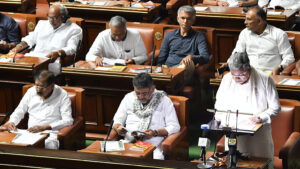
The flashpoint for the protest was a rare and dramatic incident in the Karnataka legislative assembly on January 22, 2026, when Governor Thawarchand Gehlot walked out of a joint session after reading only the opening lines of his address and declined to read the full speech prepared by the state government. Rather than delivering the complete, cabinet-approved text, he chose to depart shortly after beginning his remarks, a move that provoked sharp reactions from ruling party legislators.
Traditionally, the Governor’s address to the legislature — particularly in special sessions — is a ceremonial occasion, but it also carries political significance because it outlines the government’s priorities and perspective. What made this incident especially controversial was the report that the Governor refused to read particular paragraphs in the address that were critical of central government policies, particularly regarding employment guarantee schemes. According to multiple reports, the Governor sought deletions from the text, and upon failing to reach agreement, he chose to deliver only a minimal statement before departing.
Explosive Reactions Inside the Assembly
The moment the Governor walked out of the joint session, the atmosphere in the legislature turned chaotic. Members of the ruling Congress party, including lawmakers from both the Legislative Assembly and Council, vocally condemned the Governor’s departure. Some tried to stop him as he exited, while others raised slogans condemning the act as contrary to constitutional norms. There was pushing and shouting on the assembly floor, and senior Congress leaders condemned the walkout fiercely.
The intensity of the reaction reflected deep frustration with what the government viewed as an overreach by the Governor, who is constitutionally appointed as the state’s nominal head. Chief Minister Siddaramaiah was among those sharply critical of the Governor’s conduct, asserting that a Governor has a constitutional duty to read the address prepared by the elected government. The Congress leadership also floated the possibility of challenging the Governor’s actions in court, raising constitutional questions about the limits of the Governor’s discretion in such matters.
“Go Back Governor”: Protest or Political Strategy?
The slogan “Go Back Governor” quickly became associated with protests and political messaging directed at the Raj Bhavan. Demonstrations, rallies, and marches were organised by party supporters and opposition members alleging interference by the Governor in the state government’s constitutional functions. Critics said the Governor’s walkout was not simply a ceremonial quirk but signalled partiality and political bias at the expense of democratic norms.
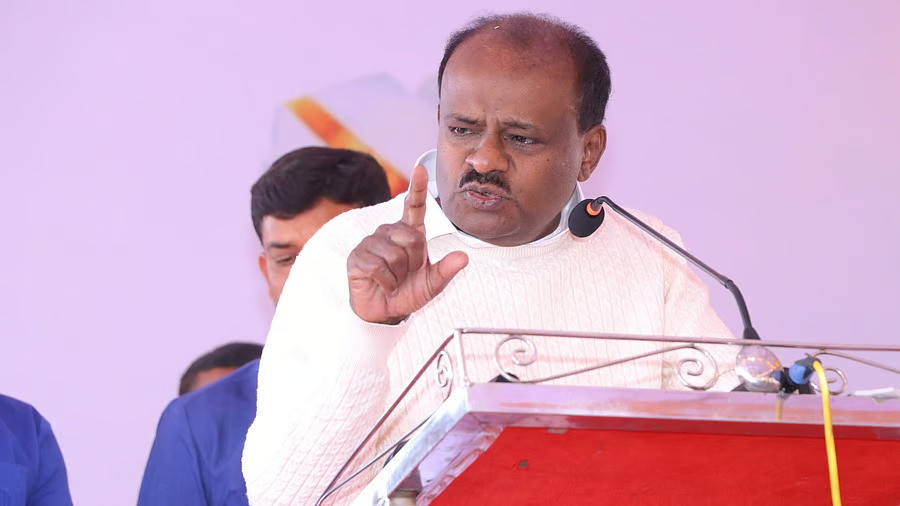
Into this charged atmosphere stepped H. D. Kumaraswamy, a union minister and senior leader with a long political career in Karnataka. In public comments, Kumaraswamy dismissed the protests and the slogan as political drama. He argued that the ruling Congress was engaging in a deliberate confrontation rather than focusing on governance and said that such tactics would not resolve the state’s problems. His remarks labelled the protest a “scripted demonstration” meant to divert attention from more pressing issues, implying that the political theatre around the Governor’s presence was being exploited for partisan advantage rather than genuine constitutional concern.
Kumaraswamy also recalled past instances where Governors had acted in contentious ways, suggesting that the present conflict was not unique to this administration and warning against overreacting to routine constitutional frictions. He criticised the Congress for what he viewed as using the protest to score political points and pointed to larger governance challenges the state faced, including economic and social issues that required attention.
Constitutional and Political Underpinnings
To understand the significance of the protest and the response, it helps to appreciate the constitutional framework of Indian federalism. Under Article 176 of the Indian Constitution, the Governor addresses the state legislature, typically communicating the government’s priorities. While the Governor acts on the advice of the state cabinet in such matters, a long-standing debate exists over the extent of the Governor’s discretion, especially when it comes to content that may be politically sensitive.
In the Karnataka case, legal experts and commentators pointed out that a Governor’s refusal to deliver a full address raises questions about the balance between ceremonial duty and personal discretion. Critics of the Governor argued that refusing to read portions of a cabinet-approved speech could be seen as undermining the elected government’s prerogative. Supporters of the Governor’s action, including opposition leaders, countered that the Raj Bhavan is within its rights to object to content perceived as excessively political or critical without substantive basis.
This constitutional debate overlaps with political tensions between state and central governments in India. Karnataka’s ruling party and the Governor’s office represent different political sensibilities, and the confrontation highlighted how constitutional roles can become entangled with partisan narratives.
Public Reaction and Media Discourse
Public response to the protest and the dramatic exchange in the assembly was mixed. Supporters of the Congress government hailed the protests as a defence of Karnataka’s democratic autonomy and a stand against what they saw as undue influence. Opponents and critics echoed Kumaraswamy’s line, framing the slogans and demonstrations as theatrical and pointed out that political posturing had overshadowed real governance issues. Analysts in media and civil society commentary pointed to the broader trend of institutional friction in Indian politics, where ceremonial roles like those of Governors have increasingly become flashpoints.
The episode also sparked broader discussion about how political parties mobilise supporters, project narratives, and turn institutional disagreements into political opportunities. For some commentators, the “Go Back Governor” slogan seemed part of a strategy to galvanise party ranks and supporters, especially in an election cycle where visibility and voter engagement carry high stakes.
Political Context and Recent Governance Debates
While this event was remarkable in its own right, it did not occur in isolation. Karnataka’s political landscape has been charged in recent years, with debates over corruption investigations, employment schemes, and state-centre relations all contributing to an atmosphere of heightened political competition. For instance, controversy surrounding prosecution sanctions and policy differences between the Congress-led state government and central authorities had already stirred tensions. The Governor’s actions and the subsequent protest unfolded against this backdrop of ongoing friction between state and national party interests.
Kumaraswamy’s attempt to frame the protest as political drama reflects this broader context. As a senior political figure with experience in state governance, he echoed sentiments that such confrontations distract from policy implementation and economic development. His remarks also underscore enduring divisions within Indian politics, where state leaders often criticise institutional conduct as politically motivated rather than principled.
What This Means for Karnataka’s Political Future
The “Go Back Governor” episode is likely to influence Karnataka’s political discourse in the coming months. It raises enduring questions about the boundary between constitutional office and political practice, and how elected governments navigate relations with appointed figures like Governors. The reaction from leaders such as H. D. Kumaraswamy suggests that rather than quieting tensions, the incident may deepen partisan narratives and shape electoral strategies.
For the public, this may translate into ongoing debate about democratic norms, respect for institutional roles, and the nature of protest in contemporary politics. Whether the protest succeeded in highlighting legitimate constitutional concerns or simply became a stage for political posturing will depend largely on how future actions play out between the state government and the Raj Bhavan.
In the end, the “Go Back Governor” protest illustrates the complex interplay between constitutional formality and political strategy in India’s vibrant democracy. It underscores that even ceremonial actions can become rallying points for broader political conflict, and that leaders will interpret these moments through the lens of their own political goals and critiques.
FACTS Transcripts proudly serves students and professionals across a wide range of regions to support their academic and career goals. Our services are available in:
India
United States
Canada
United Kingdom
New Zealand
Australia
Russia
Middle East
North America
Africa
Our Services – FACTS Transcripts
We at FACTS Transcripts assist in various services, including:
Mark Sheet Transcripts
E-Transcripts
Duplicate Mark Sheets & Degree Certificates
Medium of Instructions Certificates
Attestations
HRD Attestation / Apostille Services
ECA (Educational Credentials Assessment)
Trusted by leading global verification organizations, including WES, IQAS, PEBC, NDEB, NASBA, CAPR, NZQA, ICAS, NCESS, ICES, ECE, eduPASS, ACEI, GCEUS, Comparative Education Services, NNAS, NCA, SAQA, QMAS, FORAC, Australian Pharmacy Council, and more.
FACTS Transcripts – The preferred choice for university document verification worldwide. We ensure a hassle-free process for obtaining your transcripts.