

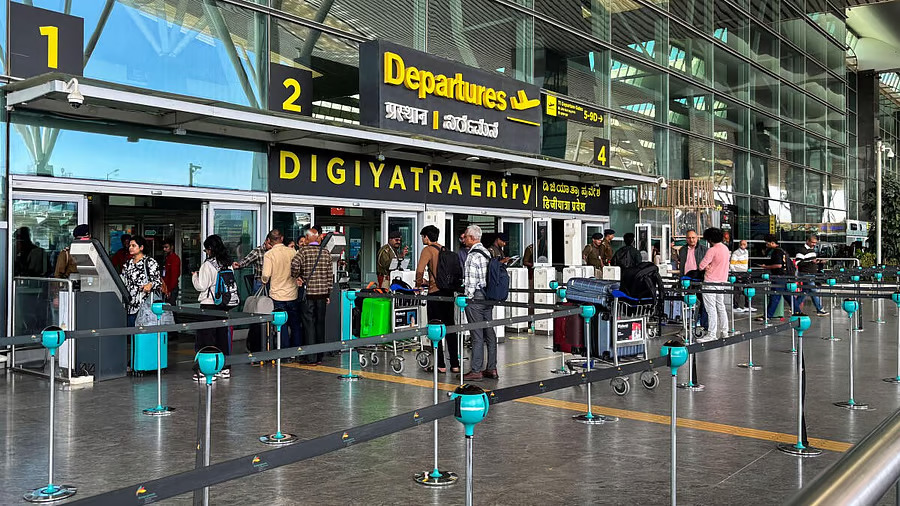
In a highly unusual incident that has captured global attention, a British national was detained by Indian authorities at Kempegowda International Airport (KIA) in Bengaluru after it emerged that a Sri Lankan national had travelled to London using the British man’s boarding pass. The case took place on January 18, 2026, when airline and immigration officials uncovered what appeared to be a deliberate attempt to circumvent visa rules and immigration protocols — sparking concerns about aviation security and international law violations.
The incident is not just a bizarre travel story; it highlights potential vulnerabilities in international boarding and immigration control systems, and illustrates how determined fraudsters can try to exploit procedural gaps. Authorities are now conducting a thorough inquiry to determine motive, responsible parties, and whether the case points to broader criminal networks — perhaps even involving human trafficking or job fraud.
The Strange Sequence of Events
The drama began with a 52-year-old United Kingdom national, identified as Kandiah Rajagopal, who had purchased a ticket and boarding pass for a Virgin Atlantic flight from Bengaluru to London. Rajagopal arrived at the airport with legitimate travel documents and underwent standard checks at security and immigration along with other passengers.
Simultaneously, a Sri Lankan national named Sharusan Kunasekaran was at the airport, holding a ticket to Singapore, but he lacked a valid UK visa — which would be necessary for entry into the United Kingdom. Both men cleared initial security and immigration controls using their respective tickets and boarding passes.
Here’s where the unusual twist occurred: after passing through the routine security checks, the two individuals met in an airport washroom and exchanged boarding passes. The Sri Lankan national subsequently boarded the London-bound flight using Rajagopal’s boarding pass, even though he did not hold the necessary visa to enter the UK. Rajagopal remained behind at the airport but stayed within the secure departure area, reportedly lingering for over eight hours.
Airport officials grew suspicious of Rajagopal’s behaviour and conducted further checks. When airline and immigration personnel verified the boarding pass with the airline’s database, they discovered that the passenger who had boarded the London flight did not match the passport details of Rajagopal. Further investigations revealed the boarding pass had been used by the Sri Lankan national, prompting the arrests.
Arrest and Legal Action
After the inconsistencies surfaced, Rajagopal was taken into custody by airport police under charges including violations of the Immigration and Foreigners Act. He was later remanded to judicial custody and sent to Central Prison, Parappana Agrahara in Bengaluru while authorities continued to probe the case.
Meanwhile, the Sri Lankan national, whose identity and whereabouts were traced by immigration officials in the United Kingdom, was detained by UK authorities. He is expected to be deported to Sri Lanka as part of corrective action, given that he travelled without a valid visa and on a boarding pass issued to someone else.
The legal issues here are significant: using someone else’s boarding pass to travel across international borders is not merely a logistical violation — it constitutes fraud, misrepresentation, and potential immigration offences under Indian law and likely under the immigration laws of the UK and Sri Lanka as well.
Concerns Around Airport and Immigration Security
This incident has triggered debate about how two individuals could potentially bypass safeguard mechanisms at different stages of the airport and immigration process:
Security screening systems are designed to match a passenger’s identity with their ticket and boarding pass before they enter restricted zones. Yet in this case, both individuals passed security — possibly because they initially had valid tickets and matching passports.
Immigration controls generally prevent travellers without valid visas from boarding international flights or leaving a country. However, the fraud was only detected after airline checks were correlated with immigration exit stamps.
The incident exposes how unexpected human behaviour, such as swapping boarding passes after security clearance, can defeat routine automated checks if protocols are not stringent at every stage.
Airport and immigration officials are now reviewing procedures to prevent similar incidents, especially as international passenger traffic continues to grow and security remains a top priority for global aviation networks.
Possible Motives and Broader Issues
Authorities are examining why Rajagopal and Kunasekaran attempted this risky strategy. One proposed motive is that the Sri Lankan national sought to reach the UK illegally, given he did not possess a UK visa. Illegal migration for employment opportunities or better living conditions can be a powerful motivator, though it entails profound legal and personal risks.
Investigators are also considering whether there might be elements of human trafficking, job fraud, or coordination with larger smuggling operations — although definitive evidence has not yet emerged. Human trafficking networks sometimes exploit vulnerabilities in border controls, and while this case could be isolated, it may also help officials identify patterns they had not previously noticed.
Global Context: Similar Cases and Security Lessons
This is not the first time boarding pass misuse has led to arrests. In past years, there have been documented cases at major airports where passengers swapped boarding passes to fly to destinations they weren’t entitled to travel to, sometimes even using forged passports or fraudulent documents. In a notable case at another major Indian airport, two foreign nationals exchanged boarding passes to fly to different international destinations before security checks uncovered the misrepresentation.
Such precedents show that while airports have multiple layers of security, determined fraudsters can attempt creative strategies to get around controls. This underscores the need for real-time identity verification technologies, closer integration between airline bookings and immigration systems, and continuous training for security staff to recognize unusual behaviour.
What This Means for International Travel
This incident at Bengaluru airport sends several clear signals to the global travel community:
Travellers must use valid tickets and travel documentation that corresponds directly with the identity linked to those documents. Using someone else’s boarding pass is unlawful in nearly all jurisdictions and can lead to arrests and criminal records.
Airport and immigration authorities will be vigilant. Airports around the world monitor unusual behaviour, and cooperation between airline databases, immigration systems, and security personnel is critical to prevent unauthorized travel.
International cooperation matters. In this case, alerts from Indian authorities led to action in the UK, demonstrating how cross-border law enforcement cooperation can quickly rectify fraudulent attempts to enter another country.
Conclusion: A Cautionary Tale for Air Travel in the Modern Era
The boarding pass fraud case at Kempegowda International Airport highlights both the ingenuity of individuals trying to exploit travel systems and the importance of strong aviation security and immigration controls. What may have begun as an attempt to help an acquaintance reach a destination turned into a complex legal case involving multiple jurisdictions, arrests, and questions about safety protocols.
FACTS Transcripts proudly serves students and professionals across a wide range of regions to support their academic and career goals. Our services are available in:
India
United States
Canada
United Kingdom
New Zealand
Australia
Russia
Middle East
North America
Africa
Our Services – FACTS Transcripts
We at FACTS Transcripts assist in various services, including:
Mark Sheet Transcripts
E-Transcripts
Duplicate Mark Sheets & Degree Certificates
Medium of Instructions Certificates
Attestations
HRD Attestation / Apostille Services
ECA (Educational Credentials Assessment)
Trusted by leading global verification organizations, including WES, IQAS, PEBC, NDEB, NASBA, CAPR, NZQA, ICAS, NCESS, ICES, ECE, eduPASS, ACEI, GCEUS, Comparative Education Services, NNAS, NCA, SAQA, QMAS, FORAC, Australian Pharmacy Council, and more.
FACTS Transcripts – The preferred choice for university document verification worldwide. We ensure a hassle-free process for obtaining your transcripts.