
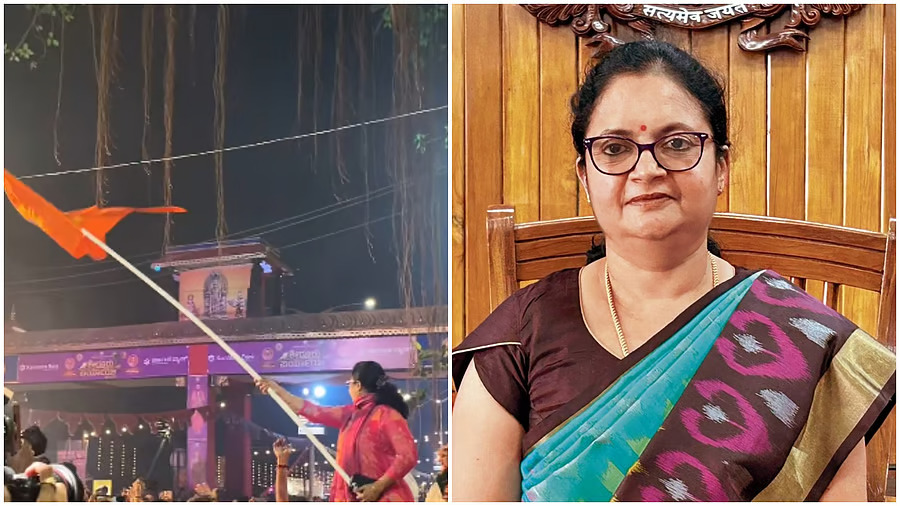
In the coastal town of Udupi, Karnataka, a political and administrative controversy has erupted amid allegations that the Deputy Commissioner (DC), T K Swaroopa, violated service rules and constitutional principles by publicly holding and waving a saffron flag, associated with the Rashtriya Swayamsevak Sangh (RSS), during the Paryaya Procession on January 18, 2026. The issue has sparked intense debate among political parties, civil servants, and local residents, reflecting deeper questions about secularism, administrative neutrality, religious symbolism, and political communication in India.
The Incident That Sparked the Row
The controversy centers around the Paryaya festivities in Udupi, an ancient and culturally rich tradition marking a ceremonial rotation of custodianship of the Udupi Sri Krishna Temple among the eight mathas (monastic institutions) that manage it. The event draws thousands of devotees and holds immense religious importance, blending culture, ritual, and community identity.
During the early morning procession from Jodu Katte to Sri Krishna Math, a saffron flag — reportedly handed to the Deputy Commissioner by a local MLA — was displayed prominently by her as she flagged off part of the ceremonial procession. The saffron flag used has been identified in public reporting as associated with a political volunteer organisation.
Shortly after the images and videos circulated, the Udupi District Congress Committee’s Legal and Human Rights Cell wrote to Karnataka Chief Minister Siddaramaiah and other senior officials demanding action against Swaroopa, alleging that her conduct violated government service rules and the constitutional principle of secularism expected of a civil servant. The objection was based on the argument that an administrative officer should not publicly display or be seen endorsing symbols linked to a particular political ideology or organisation, especially in an official capacity.
Political Reactions and Rising Tensions
The political reactions have been swift and sharply divided. The Congress party has criticised the DC’s conduct as “grave misconduct” that breached both administrative norms and the secular ethos of the Constitution. The party’s representation urged a detailed inquiry and appropriate legal action, pointing out that tying a government official publicly to partisan symbols undermines the neutrality expected of the civil service.
Bharatiya Janata Party (BJP) leaders, however, strongly defended the Deputy Commissioner’s actions, branding the Congress demand as an overreaction and a misunderstanding of cultural symbolism. BJP district leaders described the saffron flag as a significant part of local religious tradition rather than a political emblem, condemning the opposition’s letter as an attempt to politicise a long-standing cultural procession. They also framed the controversy as an example of what they see as Congress’s negative stance toward Hindu traditions and cultural celebrations.
One senior BJP figure publicly argued that waving the saffron flag is an expression of cultural identity, citing historic meanings attached to the colour, and claimed that such symbolism should not be misconstrued as political misconduct.
Deputy Commissioner’s Clarification
Amid growing political heat, the Deputy Commissioner clarified her position, asserting that she participated in the Paryaya event strictly in her official capacity and did not intend to make a political statement. She explained that administrative officials often take part in significant local ceremonies as part of their roles, especially in civic and cultural functions where public engagement and coordination are important. According to her statement, participation in the ceremonial activities, including the flag-off, was related to her duties as the administrator and not a political endorsement.
This explanation highlights a recurring administrative dilemma in India: how civil servants voluntarily interact with religious and cultural events that are deeply embedded in local traditions without compromising their constitutional neutrality.
Understanding the Paryaya Tradition
To fully appreciate why this seemingly simple act of displaying a flag gained political significance, it helps to understand the context of the Paryaya system. Udupi’s temple tradition dates back centuries and involves a rotational custodianship of the main Krishna temple among the eight mathas. Every two years, the responsibility — both ritual and administrative — passes from one matha to another in a grand festival marked by processions, rituals, and community celebrations. The Paryaya Mahotsava is widely regarded as one of the most important religious and cultural events in coastal Karnataka, drawing believers and tourists alike.
In such a setting, symbols like flags, music, and colours play a significant part in ceremony and identity. Saffron, in particular, has deep historical connections in Indian spiritual and religious traditions, symbolising sacrifice, devotion, and renunciation in many Hindu philosophies. Yet in contemporary public life, the same colour and closely associated flags have also become tied to political organisations and ideologies, creating a complex landscape where cultural and political meanings intersect.
The Constitutional and Administrative Debate
At the core of the controversy lies an important constitutional question: what is the boundary between cultural participation and political endorsement for government officials? In India, the civil service is expected to function impartially and uphold the secular character of the Constitution. This means that officials must refrain from endorsing political symbols or activities in their official roles. While participation in cultural or religious events is commonplace for administrators, public engagement with symbols associated with political entities can raise questions about neutrality and propriety.
Critics of the DC’s act argue that by waving a flag linked with a political organisation, the official inadvertently crossed this boundary, giving rise to legitimate concerns about whether public servants should visibly align — even symbolically — with any ideological representation. Supporters counter that cultural festivals often include historical religious symbols and that avoiding them altogether could undermine the ceremonial essence of these traditions.
Determining where to draw this line is not always straightforward, especially in regions where religious celebrations and community life are deeply entwined. Yet the debate in Udupi highlights how public perception and political context can transform what might appear to be a routine ceremonial participation into an issue of national interest.
Wider Implications for Governance
The Udupi case has attracted attention beyond the district, prompting discussions about civil service conduct, secularism, and political discourse in public administration. It has raised questions about whether current service rules provide enough clarity to officials participating in public events that are simultaneously religious and cultural.
Critics have emphasised the need for clearer guidelines that help civil servants navigate situations where cultural symbolism overlaps with political connotations. Advocates for stricter administrative discipline argue that public servants should maintain visible neutrality to foster public trust in government institutions.
Conversely, others suggest that rigid approaches risk alienating local communities, especially in regions where religion and tradition play central roles in communal identity and daily life. This perspective emphasizes the importance of balancing constitutional secularism with respect for local customs.
Social and Cultural Reactions
The controversy has also stirred wider social discussion. Many local residents view the Paryaya event as primarily a religious and cultural celebration that transcends political boundaries. For them, symbols like the saffron flag are part of centuries-old tradition and not necessarily linked to contemporary political identities.
Others argue that the connotations of such symbols have shifted over time, and in today’s political climate, it’s nearly impossible to separate cultural meaning from political interpretation, particularly when political figures or party representatives participate in ceremonial events.
Conclusion: Symbolism, Governance, and Public Debate
The Udupi saffron flag controversy encapsulates the complex interplay between culture, politics, and administrative conduct in modern India. What began as a ceremonial act at a revered local festival has triggered a broader conversation about constitutional principles, neutrality in public service, and how tradition is interpreted through the lens of contemporary politics.
At a time when symbols carry layered meanings in the public sphere, incidents like these highlight the need for dialogue on how civil servants engage with cultural life while maintaining the trust and impartiality that are central to democratic governance.
FACTS Transcripts proudly serves students and professionals across a wide range of regions to support their academic and career goals. Our services are available in:
India
United States
Canada
United Kingdom
New Zealand
Australia
Russia
Middle East
North America
Africa
Our Services – FACTS Transcripts
We at FACTS Transcripts assist in various services, including:
Mark Sheet Transcripts
E-Transcripts
Duplicate Mark Sheets & Degree Certificates
Medium of Instructions Certificates
Attestations
HRD Attestation / Apostille Services
ECA (Educational Credentials Assessment)
Trusted by leading global verification organizations, including WES, IQAS, PEBC, NDEB, NASBA, CAPR, NZQA, ICAS, NCESS, ICES, ECE, eduPASS, ACEI, GCEUS, Comparative Education Services, NNAS, NCA, SAQA, QMAS, FORAC, Australian Pharmacy Council, and more.
FACTS Transcripts – The preferred choice for university document verification worldwide. We ensure a hassle-free process for obtaining your transcripts.