
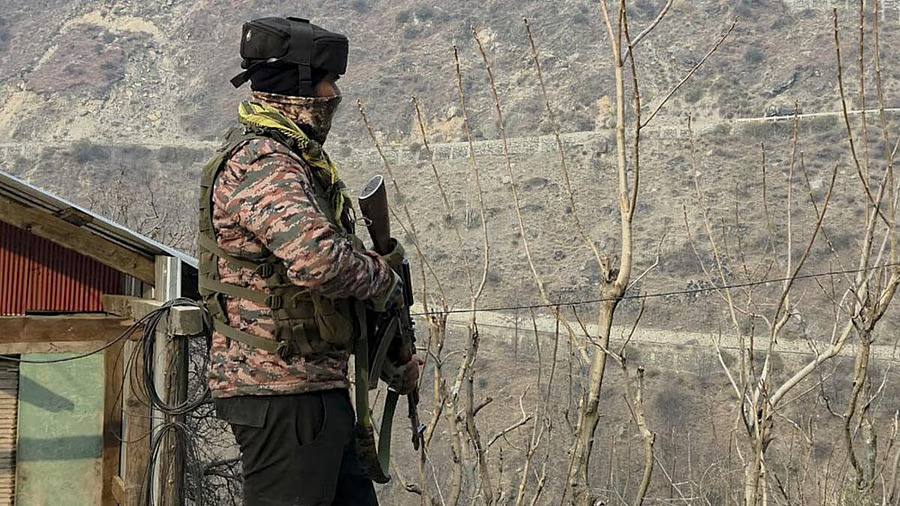
In the rugged, snow-clad mountains of Jammu and Kashmir’s Kishtwar district, a dramatic confrontation between Indian security forces and militants has unearthed far more than weapons and gunfire. What began as a high-altitude military engagement evolved into a broader revelation about how terror networks sustain themselves in hostile, isolated terrain. A curious detail — stockpiles of food items including basmati rice, noodles, vegetables, spices, and cooking fuel — raised difficult questions: How did these supplies get there? Who helped transport and hide them? The discovery has now put the terror supply chain firmly under the scrutiny of security agencies across the region.
The events unfolded during a counter-terror operation in an area known for its steep slopes, dense forests, and treacherous weather. Intelligence inputs had indicated the presence of foreign militants, believed to be linked with a Pakistan-based extremist group. Acting on these leads, a joint task force comprising elements of the Indian Army, Jammu & Kashmir Police, and paramilitary units launched a search operation in the Singhpora and Sonnar belts of Kishtwar, well above 12,000 feet in elevation.
As the forces progressed through the icy passes, they came under sudden and intense fire. The militants were well-prepared, launching a barrage of grenades and AK-47 fire from elevated, camouflaged positions. The ensuing firefight was fierce, claiming the life of a Special Forces commando and injuring several other soldiers. Despite the challenging combat conditions, the security cordon remained intact and operations continued as planned.
After hours of combat, forces pushed forward into the suspected hideout zone. What they uncovered surprised even seasoned officers.
Deep inside a stone-lined bunker — constructed like a fortress and deliberately concealed from aerial and ground surveillance — lay a meticulously planned survival setup. Far from being a temporary refuge, this subterranean structure was stocked to last through months of harsh winter conditions. Large sacks of basmati rice and grains, crates of fresh tomatoes and potatoes, dozens of packets of instant noodles, cooking gas cylinders, firewood, and at least fifteen different spices were found resting among utensils, blankets, and other essentials.
This was not the typical logistical support one expects in a brief shelter. The stocks were sufficient to sustain a small group through several months of snowbound isolation, raising critical questions about the extent and sophistication of militant provisioning. Food supplies usually associated with civilian life — quality rice, vegetables, diverse spices — indicated not only careful planning but also possible connections to local supplies.
The idea of militants at 12,000 feet surviving on instant noodles and biryani rice struck both security personnel and media alike. What stood out was not simply the presence of food but the quality and volume of rations — far more than expected for a brief hideout. Analysts described it as akin to discovering a remote wilderness kitchen ready for long-term habitation. The trope quickly spread in reports: how did something as ordinary as biryani ingredients make their way to a hidden mountain bunker?
This question encapsulates the deeper concern of the security establishment — the terror supply chain. Constructing and sustaining such a bunker in extreme cold, at such altitude, with these supplies, suggests more than individual effort. It implies a network of help, logistics, and possibly local contacts who could transport heavy food items, gas cylinders, and construction materials without arousing suspicion. The discovery has prompted investigators to broaden their inquiry beyond the militants themselves and focus on the ancillary support system that enabled them to survive in such isolation.
Investigators have detained several suspected individuals from nearby villages for questioning, aiming to trace how rations and other materials reached the militants. Local overground workers, known as OGWs within security parlance, are often suspected in such cases. These are individuals who, whether out of ideological affinity, coercion, or financial incentive, provide shelter, supplies, or intelligence to militants.
Security forces believe that without some form of local assistance, the militants would have struggled to transport and stockpile supplies in such volume and quality. The presence of branded rice, fresh vegetables, and multiple spices — not common in a remote, high-altitude forest — suggests planned resupply rather than scavenging or one-off transport.
The terrain itself adds complexity. Kishtwar’s forest belts are some of the most unforgiving in the entire region. Winters bring heavy snowfall, cutting off access routes and making movement perilous. Setting up a bunker here wasn’t a spur-of-the-moment decision; it signaled a long-term survival strategy, indicative of deliberate positioning and logistical support over time.
Security agencies have also noted that the construction of the bunker — stone-lined walls, concealed entrances, and integrated storage — points to training and experience. This wasn’t a hastily dug hideout but a purpose-built stronghold. Given its sophistication, the bunker may well have served as part of a larger network of safe havens used by militants to evade detection, regroup, and plan further actions.
The human cost of this operation has been stark. A brave soldier paid the ultimate price during the encounter, highlighting the high stakes of counter-terror operations in such environments. His sacrifice underscores the risks that security personnel face in remote counter-insurgency deployments, where militants are often dug in with prepared positions and the advantage of terrain.
What is emerging from this episode is a broader picture of the challenges posed by militancy in the region. It is no longer just about isolated gunmen with weapons; it is about how they are supplied, sheltered, and sustained over months. It is about the networks — visible or hidden — that make such survival possible. And it is about how these networks operate in, and potentially exploit, civilian populations and logistics channels.
For authorities, this incident has become a case study in the complexity of modern counter-terrorism. It is not merely about eliminating militants on sight but cutting off their lifelines, disrupting their supply chains, and dismantling the support structures that allow them to hide in the first place.
The “biryani question” has therefore become symbolic. It is not really about a food item; it is about understanding how terror outfits adapt, sustain themselves, and integrate into otherwise inaccessible areas with the help of local networks. It questions the depth of support systems — logistical, human, and material — that surround these outfits. And it calls for a reassessment of how security forces approach these operations, blending tactical combat with intelligence, local cooperation, and broader strategic disruption of terror networks.
In the coming weeks and months, investigations are likely to expand. Interrogations, data analysis, and local inquiries will attempt to chart the trail of supplies and uncover those who provided them. Only by mapping these hidden support networks can the circle of terror sustainment be truly broken.
The Kishtwar encounter stands as a stark reminder that counter-terrorism is not only fought with rifles and grenades but also through vigilance, community cooperation, and an unwavering focus on unraveling the unseen threads that bind militants to their supplies and survival. The story of a remote bunker full of food has opened a larger chapter about terror supply chains — a chapter that will shape future security strategies in the region.
FACTS Transcripts proudly serves students and professionals across a wide range of regions to support their academic and career goals. Our services are available in:
India
United States
Canada
United Kingdom
New Zealand
Australia
Russia
Middle East
North America
Africa
Our Services – FACTS Transcripts
We at FACTS Transcripts assist in various services, including:
Mark Sheet Transcripts
E-Transcripts
Duplicate Mark Sheets & Degree Certificates
Medium of Instructions Certificates
Attestations
HRD Attestation / Apostille Services
ECA (Educational Credentials Assessment)
Trusted by leading global verification organizations, including WES, IQAS, PEBC, NDEB, NASBA, CAPR, NZQA, ICAS, NCESS, ICES, ECE, eduPASS, ACEI, GCEUS, Comparative Education Services, NNAS, NCA, SAQA, QMAS, FORAC, Australian Pharmacy Council, and more.
FACTS Transcripts – The preferred choice for university document verification worldwide. We ensure a hassle-free process for obtaining your transcripts.