
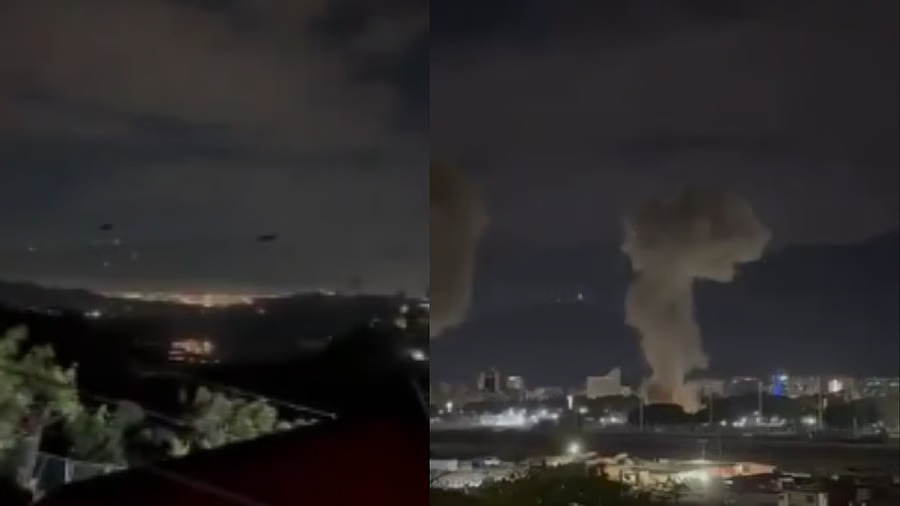
Tensions in Latin America escalated dramatically after the United States launched targeted airstrikes on Venezuelan territory, following a series of strong warnings issued by former US President Donald Trump against Venezuelan President Nicolás Maduro. The strikes sent shockwaves across the region, triggering loud explosions, plumes of smoke rising into the sky, and widespread concern among civilians living near the affected areas.
The sudden military action marks one of the most serious escalations between Washington and Caracas in recent years, raising fears of broader instability in South America and renewed geopolitical rivalry involving global powers.
The Night of the Strikes: Fear and Confusion on the Ground
Residents in multiple Venezuelan cities reported hearing loud aircraft engines overhead, followed by powerful explosions that rattled buildings and shattered windows. Thick columns of smoke were seen rising from strategic locations, including military installations and infrastructure believed to be connected to Venezuela’s defense and security network.
Eyewitnesses described scenes of panic as people rushed indoors, uncertain of the scale of the attack or whether further strikes would follow. Emergency services were placed on high alert, while local authorities urged civilians to remain calm and avoid targeted zones.
While official casualty figures were not immediately released, reports indicated damage to facilities linked to the Venezuelan military. The atmosphere remained tense throughout the night, with continued aerial activity reported in surrounding regions.
Trump’s Warnings and the Lead-Up to Military Action
The airstrikes followed a series of public and private warnings from Donald Trump, who accused the Maduro government of destabilizing the region, threatening US interests, and failing to meet international expectations on governance and democracy.
Trump’s statements suggested that Washington was prepared to take decisive action if Venezuela continued what he described as hostile behavior. These warnings, issued days before the strikes, were widely interpreted as signaling possible military intervention.
Analysts note that the decision to proceed with airstrikes reflects a broader strategy of exerting maximum pressure on Caracas, combining diplomatic isolation, economic sanctions, and now direct military force.
Washington’s Justification for the Strikes
US officials defended the operation as a limited and targeted action aimed at protecting national security interests and preventing further destabilization in the Western Hemisphere. According to official statements, the strikes were designed to weaken specific capabilities of the Venezuelan government without targeting civilian populations.
The United States emphasized that the operation was not intended as a declaration of war but rather as a warning to the Maduro administration. Officials reiterated that further actions would depend on Venezuela’s response in the coming days.
Venezuela’s Response: Condemnation and Defiance
The Venezuelan government strongly condemned the strikes, calling them a violation of national sovereignty and international law. President Nicolás Maduro accused the United States of aggression and warned that Venezuela would defend itself against any foreign intervention.
In a televised address, Maduro stated that the nation would not bow to external pressure and framed the attack as part of a long-standing campaign to undermine Venezuela’s independence. He called on the international community to denounce the action and stand against what he described as imperialist interference.
Venezuelan military forces were placed on heightened alert, and air defense systems were reportedly activated across key regions.
International Reactions: Global Concern Grows
The airstrikes drew mixed reactions from the international community. Some US allies expressed cautious support, emphasizing the need to address instability in Venezuela, while others urged restraint and called for immediate de-escalation.
Several countries voiced concern over the potential for civilian harm and the risk of the conflict expanding beyond Venezuela’s borders. International organizations called for dialogue and warned that military escalation could worsen an already fragile humanitarian situation in the country.
Global powers with strategic interests in Venezuela closely monitored developments, underscoring the broader geopolitical implications of the strike.
Impact on Civilians and the Humanitarian Situation
Venezuela has already been grappling with economic hardship, shortages of basic goods, and large-scale migration. The airstrikes added another layer of uncertainty for ordinary citizens, many of whom fear that continued conflict could further disrupt daily life.
Hospitals and emergency responders prepared for potential casualties, while families in affected areas sought safety amid rumors of additional attacks. Humanitarian groups warned that prolonged military tension could worsen access to food, medicine, and essential services.
Strategic Implications for the Region
Experts believe the strikes could reshape regional dynamics in Latin America. Neighboring countries are concerned about spillover effects, including refugee movements and economic instability. The situation also risks drawing in external powers, turning Venezuela into a focal point of global strategic competition.
The use of military force marks a significant shift from previous diplomatic and economic measures, signaling that Washington may be willing to escalate further if its demands are not met.
What Comes Next: A Fragile and Uncertain Future
As of now, the situation remains volatile. While no immediate follow-up strikes were confirmed, both sides appear to be preparing for potential escalation. Diplomatic channels remain strained, and trust between Washington and Caracas is at an all-time low.
The coming days will be critical in determining whether this confrontation leads to broader conflict or prompts renewed international efforts toward negotiation and de-escalation.
Conclusion: A Turning Point in US–Venezuela Relations
The US airstrikes on Venezuela represent a dramatic turning point in an already tense relationship. With loud explosions echoing across Venezuelan cities and smoke rising into the night sky, the message sent was unmistakable.
Whether this show of force will achieve its intended political objectives or further entrench divisions remains to be seen. What is clear is that the people of Venezuela now face another chapter of uncertainty, as global attention turns once again to the fragile balance of power in the region.
FACTS Transcripts proudly serves students and professionals across a wide range of regions to support their academic and career goals. Our services are available in:
India
United States
Canada
United Kingdom
New Zealand
Australia
Russia
Middle East
North America
Africa
Our Services – FACTS Transcripts
We at FACTS Transcripts assist in various services, including:
Mark Sheet Transcripts
E-Transcripts
Duplicate Mark Sheets & Degree Certificates
Medium of Instructions Certificates
Attestations
HRD Attestation / Apostille Services
ECA (Educational Credentials Assessment)
Trusted by leading global verification organizations, including WES, IQAS, PEBC, NDEB, NASBA, CAPR, NZQA, ICAS, NCESS, ICES, ECE, eduPASS, ACEI, GCEUS, Comparative Education Services, NNAS, NCA, SAQA, QMAS, FORAC, Australian Pharmacy Council, and more.
FACTS Transcripts – The preferred choice for university document verification worldwide. We ensure a hassle-free process for obtaining your transcripts.