

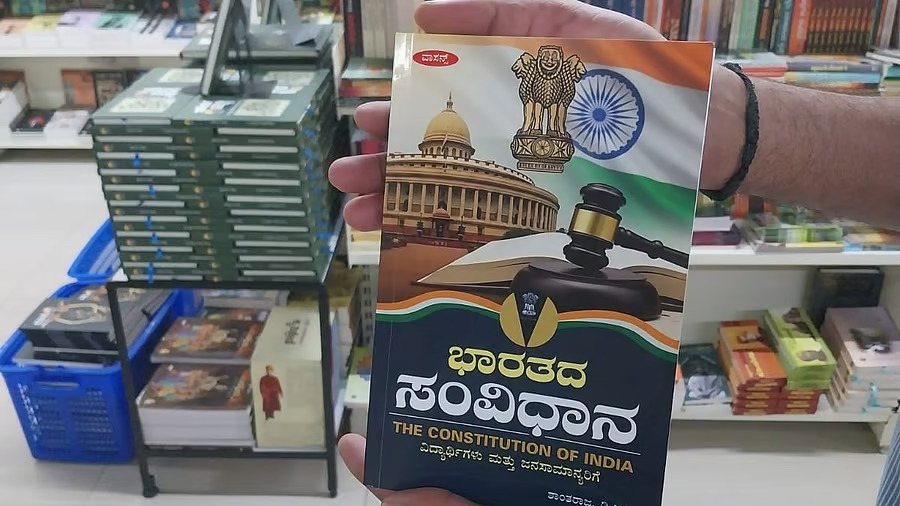
As Republic Day 2026 approached, an interesting cultural trend emerged in Bengaluru — one that differed from the usual patriotism reflected in parades and flag-hoisting ceremonies. Across the city’s bookstores, from Sapna Book House to Aakruti Pustaka and Harivu Books, there was a noticeable uptick in interest in books on the Indian Constitution, civil rights and democratic governance. Readers of all ages — students, professionals, activists and lifelong learners — were browsing the shelves for titles that explore constitutional principles, federalism, civic rights and the philosophical foundations of India’s democratic republic. This awakening of public interest in foundational law and citizen rights is both timely and meaningful, reflecting a growing curiosity about the ideas that sustain India’s democracy.
Why Reading About the Constitution Matters
The Constitution of India is much more than a legal document; it is the blueprint of the nation’s democratic values. It enshrines the rights, duties, and freedoms of every citizen and outlines the structure of government, the separation of powers, and the protections afforded to every individual. As Republic Day nears — commemorating the adoption of the Constitution on January 26, 1950 — many people see it as a moment to reconnect with the principles that define the country’s identity. For some readers, constitutional books are a way to better understand their rights and responsibilities as citizens. Others seek these books for academic purposes or to gift them at Republic Day events and quiz competitions.
This year, bookshops reported that titles in Kannada on the Constitution have been especially popular, suggesting that engagement is not limited to English-language audiences but is spreading across linguistic communities within the city. Local readers are seeking works that explain the Constitution in accessible language and reflect the democratic spirit in familiar cultural contexts.
What People Are Buying
Several specific books and genres have seen increased interest in Bengaluru’s bookstores:
Constitution primers and pocket editions: Compact versions of the Indian Constitution are popular among readers who want a concise reference or a practical companion to civic discussions. These editions make it easier for students and general readers to carry constitutional text and consult it as needed.
Explanatory texts on rights and federalism: Titles such as Fraternity Constitutional Norm and Human Need, Liberty: The Indian Story, Secularism: How India Reshaped the Idea, We, the People, and Our Constitution, Dalits and the Indian Constitution, and Socialism and the Indian Constitution have seen growing interest, according to booksellers. These works help readers unpack core constitutional values, understand their historical evolution, and explore how these concepts play out in contemporary India.
Books on governance and administrative law: Alongside constitutional texts, guidebooks and studies on governance — including works on civil service rules and land law — are being purchased, particularly by readers interested in public administration careers or a deeper understanding of how constitutional structures connect with everyday governance.
Locally written explanatory books: Kannada titles such as Samvidhana Odhu and Bharatha Samvidhana are attracting both regular patrons and new readers, including young professionals and college students who want regional perspectives on federalism and democratic rights.
Across the city’s bookshops, booksellers noted that the age group most drawn to these texts spanned from early-twenties to mid-forties, suggesting that not just older readers but also younger generations are actively exploring civic knowledge. This points to a broader trend of engaged citizenship and intellectual curiosity associated with Republic Day.
Exploring Ideas Behind the Surge
Several reasons help explain why constitutional books are selling well at this moment:
1. Republic Day Fervour and Patriotism
Republic Day is not only a celebration of national pride but also an occasion to reflect on the values enshrined in the Constitution — equality, liberty, justice and fraternity. Many readers choose this period to learn more about these subjects, either out of personal interest or as part of community and school events that emphasize national identity and civic responsibilities.
Educational institutions and civil society groups often organize talks, debates and quizzes around Republic Day, and Constitution-related books become essential resources for participants preparing for these activities.
2. Growing Public Conversations on Rights and Citizenship
There has been an increasing number of discussions in public forums, social media, academic settings and even popular culture about constitutional rights, federalism and civil liberties. These dialogues — spanning subjects as diverse as secularism, individual freedoms, social justice and governance — appear to have made many people curious to read more deeply about the Constitution itself. One bookseller in Basavanagudi noted that readers are seeking books that explain rights and democratic values in ways that are accessible and relevant to contemporary social debates.
3. Engagement With Civic Issues and Democratic Discourse
Across India, debates about civil liberties, federal structures and social justice have become frequent parts of public life. Whether in civil society activism, academic discussions, courtroom cases or political discourse, constitutional themes are often at the forefront. Readers in Bengaluru have been picking up books not just for ceremonial reasons but to better understand the legal foundations of these debates.
4. Learning and Leisure Combined
For many readers, exploring constitutional books in January becomes a form of “learning through leisure.” Just as some people pick up history books during cultural festivals, Republic Day provides a natural backdrop for engaging with texts that help understand national institutions and values. There is a blending of scholarly curiosity with everyday reading habits, making constitutional literature part of general cultural consumption.
Voices From Readers and Activists
Commentators, activists and intellectuals recommended various books that help deepen understanding and appreciation of constitutional principles. These titles range from historical accounts of the Constitution’s drafting to thematic studies on nationalism, poverty reduction, and public policy as shaped by constitutional norms. Readers and thought leaders have particularly highlighted books such as Assembling India’s Constitution, which explores how ordinary citizens engaged with the Constitution’s drafting process, and works by Rabindranath Tagore that critique and reflect on nationalism and pluralism. These recommendations emphasize not just legal knowledge but the philosophical and historical contexts that give constitutional values meaning in everyday life.
Broader Meaning: Citizenship in a Democratic Republic
This surge in demand for books about the Constitution ahead of Republic Day suggests a larger cultural moment — one in which citizens are showing an active interest in understanding the principles that sustain Indian democracy. It reflects a desire among many in Bengaluru to do more than celebrate symbolically; readers seem eager to grasp the foundations of governance, rights and civic engagement.
Rather than remaining abstract legal concepts, the Constitution and its attendant ideals are becoming subjects of inquiry, dialogue and personal reflection. Through these books, readers are asking questions about freedom, equality, justice, federal balance, secularism and individual responsibility — all of which are articulated in India’s constitutional text but also require interpretation through lived experience and historical context.
FACTS Transcripts proudly serves students and professionals across a wide range of regions to support their academic and career goals. Our services are available in:
India
United States
Canada
United Kingdom
New Zealand
Australia
Russia
Middle East
North America
Africa
Our Services – FACTS Transcripts
We at FACTS Transcripts assist in various services, including:
Mark Sheet Transcripts
E-Transcripts
Duplicate Mark Sheets & Degree Certificates
Medium of Instructions Certificates
Attestations
HRD Attestation / Apostille Services
ECA (Educational Credentials Assessment)
Trusted by leading global verification organizations, including WES, IQAS, PEBC, NDEB, NASBA, CAPR, NZQA, ICAS, NCESS, ICES, ECE, eduPASS, ACEI, GCEUS, Comparative Education Services, NNAS, NCA, SAQA, QMAS, FORAC, Australian Pharmacy Council, and more.
FACTS Transcripts – The preferred choice for university document verification worldwide. We ensure a hassle-free process for obtaining your transcripts.